
Facial retaining ligaments are the structures that hold the soft tissues of your face to the underlying bone of the skull. Think of them as anchor points — they keep the cheeks, jawline, and midface fixed in position. As you age, those same ligaments hold the line while the soft tissue around them descends, which is exactly why aging tends to show up where the ligaments sit: as the grooves, folds, and jowls that define an older face.
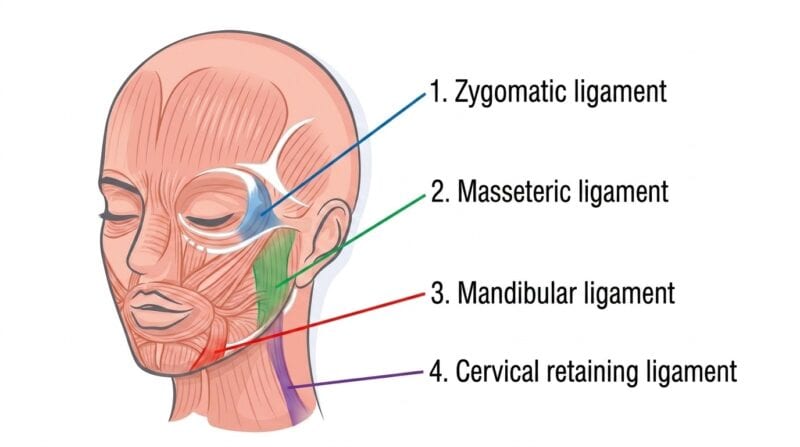
There are four primary retaining ligaments. From top to bottom:
- Zygomatic ligament — anchors the cheek soft tissue over the cheekbone.
- Masseteric ligaments — run along the front border of the masseter (chewing) muscle in the midface.
- Mandibular ligament — tethers the soft tissue at the jawline. When the tissue around it sags, you get jowls.
- Cervical retaining ligament — tethers the neck tissues between the platysma and the deeper neck; central to neck contour and the neck lift.
To lift the face, these ligaments have to be divided
Here’s the part most patients are never told: to actually lift the face, these retaining ligaments have to be divided. Many surgeons don’t divide all of them. You cannot effectively lift the face without releasing these ligaments.
This is the real reason the deep plane facelift became popular — the deep plane technique divides all of these retaining ligaments. When a patient sees a natural, un-operated deep plane result and falls in love with it, what they’re actually responding to isn’t the “deep plane” label. It’s the fact that the ligaments were fully released. Once they are, the soft tissue moves freely, the lift sits along the correct vector, and the skin is re-draped with no tension. That’s why the result looks smooth and the scars stay thin: scarring is minimized because the deep tissues are holding the lift — not the skin, and not a suture under tension.
And here’s the honest part. You can achieve much of this with more than one technique — high SMAS, deep plane, and others can all work. The name on the brochure matters far less than whether the surgeon actually releases the ligaments. That’s the lens I bring to every deep plane facelift and 4D Facelift™ I perform: the goal isn’t a buzzword, it’s a complete, controlled ligament release that lets the face move naturally.
Why so many lifts look “done” — and why revisions happen
The vast majority of the revision facelifts I see come down to one thing: the ligaments were never fully divided. The one surgeons most often shy away from is the zygomatic ligament, because it sits close to the facial nerve — releasing it safely takes experience.
When the ligaments aren’t released, some surgeons compensate by reefing the tissue with heavier-gauge sutures under tension — pulling the face tight instead of freeing it. Those lifts tend to look:
- Windswept and over-pulled
- Scarred in the deeper layers, from the constant tension on the tissue
- Distorted at the skin — poor scars, and even pixie-ear deformity
- Under-corrected in the midface, because tension applied at the edges never truly reaches the center of the face
The takeaway
The specific technique — high SMAS, deep plane, whatever it’s called on the website — matters less than what’s actually done during the operation. A natural, lasting lift comes down to fully and safely releasing the facial retaining ligaments. That’s the work. Everything else is a label.
So if you’re researching a facelift and trying to separate real surgical technique from marketing, ask any surgeon a simple question: which retaining ligaments do you release, and how do you protect the facial nerve while you do it? The answer tells you a great deal.
Ready to talk through it?
If you want a straight answer about what your face actually needs — and an honest read on the aging face and neck — that’s the conversation I have every day. Request a consultation or call 281-557-3223.
References
- Furnas DW. The retaining ligaments of the cheek. Plastic and Reconstructive Surgery (1989);83(1):11–16.
- Rossell-Perry P, Paredes-Leandro P. Anatomic Study of the Retaining Ligaments of the Face and Applications for Facial Rejuvenation. Aesthetic Plastic Surgery (2013). https://www.ncbi.nlm.nih.gov/pmc/articles/PMC3657075/
- Tarallo M, et al. Retaining Ligaments of the Face: Still Important in Modern Approach in Mid-Face and Neck Lift? Journal of Personalized Medicine (2025). https://www.ncbi.nlm.nih.gov/pmc/articles/PMC12734016/