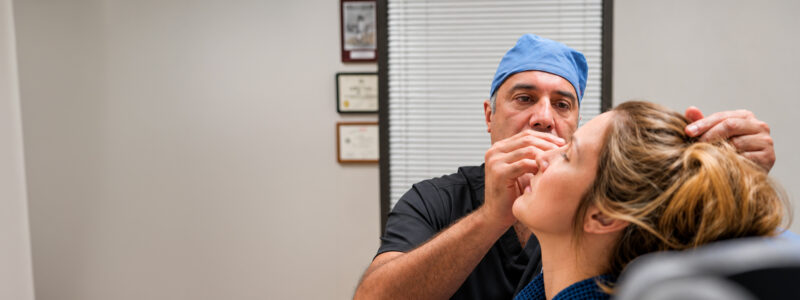
When patients talk to me about wanting their eyes to look more open, they often focus on the skin above their eyelids. But sometimes the change that would make the greatest difference is just a few millimeters higher, at the outer edge of the eyebrow.
The outer portion of the brow plays an important role in how the eyes are framed. When that area begins to descend, the eyebrow can lose some of its natural shape. The skin above the outer eyelid may appear heavier, and the eyes can take on a tired expression even when the eyelids themselves have not changed dramatically.
A temporal brow lift, sometimes called a lateral brow lift, is designed to address that outer portion of the eyebrow. Rather than elevating the entire forehead, the operation focuses on repositioning the lateral brow and improving the contour around the outer upper eye.
What interests me is how relatively little movement may be needed to make a visible difference. I don’t want every patient to have dramatically elevated eyebrows. I want to understand where their brow used to sit, how it has changed and what position would look natural for their face.
A temporal brow lift isn’t about making your eyebrows higher everywhere. It’s about restoring the position and shape of the outer brow where that correction is needed.
THE OUTER THIRD OF THE BROW
Why the Outer Eyebrow Has Such an Influence on Your Appearance
Look at the shape of an eyebrow. It doesn’t follow a straight horizontal line. The brow has a beginning near the nose, a central portion and an outer segment that helps define its overall contour.
In many women, the outer portion of the brow naturally rises toward an arch before tapering toward the temple. With age, that outer segment may descend and create a flatter appearance. The tissue between the eyebrow and the upper eyelid becomes more crowded, particularly toward the outer corner of the eye.
This is why I pay attention to the lateral brow during an examination. A patient may not have significant forehead descent or a large amount of excess eyelid skin, but a lowered outer brow may still be contributing to the tired appearance that bothers her.
Men and women also have naturally different brow shapes, although there is considerable variation between individuals. I don’t automatically create a high arch in every patient. A brow that looks natural on one face may look exaggerated on another.
My objective is to reposition the tissue appropriately for that particular patient, not to reproduce somebody else’s eyebrow shape.
INSIGHTS FROM DR. ATHRÉ
How I Approach Temporal and Endoscopic Brow Lifting

Dr. Athré explains brow anatomy, the different approaches to brow lifting and why he often combines temporal and endoscopic techniques to address different portions of the brow.
Four Things a Temporal Brow Lift Can Change
When I discuss a temporal brow lift, I want patients to understand precisely what we’re trying to improve. The operation doesn’t change every feature around the eyes, but repositioning the lateral brow can affect several aspects of the upper face.
Outer Brow Position
The primary change is elevation of the lateral eyebrow when that portion has descended from its natural position.
Brow Shape
Repositioning the outer brow can restore some of the natural arch and improve the contour toward the temple.
Lateral Eyelid Hooding
When a low brow is contributing to tissue crowding, lifting it may reduce some of the heaviness above the outer upper eyelid.
Overall Expression
A more appropriate brow position may make the upper-eye area appear more open and rested without requiring dramatic elevation.
These changes are related, but they’re not identical. Someone whose primary concern is a flattened outer brow may notice the shape most. Another patient may be more concerned about the skin crowding the outside of her upper eyelids.
I want to know which of those changes matters to you because that influences how much elevation I consider and whether a temporal lift alone is likely to accomplish your goal.
Why I Don’t Want to Lift the Outer Brow Too High
There is a difference between creating a more open appearance and creating an obviously elevated eyebrow. That distinction is one of the most important parts of planning a temporal brow lift.
If I elevate the outer brow too aggressively, I can create an exaggerated arch. The eyebrow may look unnaturally high compared with the inner portion, changing the patient’s expression in a way she never intended.
When someone comes in asking for a natural result, I don’t simply translate that into a certain number of millimeters. I look at the overall eyebrow shape, the relationship to the upper eyelid and the patient’s facial structure.
Old photographs can be useful here. They may show how the brow was shaped earlier in life and whether the current appearance represents a meaningful change.
I also evaluate the two sides separately. Most people have some natural brow asymmetry, and one eyebrow may have descended more than the other. My goal is improvement and balance, not forcing both eyebrows into an artificially identical position.
I don’t want to give you a new expression. I want to restore a more natural relationship between your eyebrow and your eye.
Where the Temporal Brow Lift Incision Goes
One of the advantages of a temporal approach is that I can access the outer brow through a relatively limited incision near the temporal hairline.
In my approach, I commonly position the incision along the hairline, within the first few rows of hair. From that location, I can work toward the lateral brow and reposition the tissue that has descended.
The position of the incision matters because the goal isn’t simply to lift the eyebrow. I also want the resulting scar to be as inconspicuous as reasonably possible. Hairline shape, hair density and the direction in which the tissue needs to move all influence my planning.
A limited incision does not mean the operation is scarless. Any surgical incision creates a scar, and healing varies. Scar visibility, temporary changes in sensation and the possibility of hair-related changes near an incision are considerations I discuss before surgery.
A temporal brow lift also isn’t the same operation as a full endoscopic brow lift. The temporal approach is directed primarily toward the outer brow, while an endoscopic approach can provide access to a broader area of the forehead and brow complex.
CHOOSING THE EXTENT OF SURGERY
Why I Sometimes Combine a Temporal Lift With an Endoscopic Brow Lift
In my earlier explanation of brow lift techniques, I described why I often prefer a combined endoscopic and temporal approach.
The reason comes down to anatomy. A temporal incision provides access to the outer portion of the brow, where I can concentrate on improving lateral elevation and shape. But some patients also have descent toward the middle or inner portion of the eyebrow.
If I only elevate the outer segment in someone who needs broader correction, the resulting brow shape may not be balanced. I may create an improved arch while leaving the central or inner brow lower than it should be.
In those patients, I may add an endoscopic component using small incisions farther back within the scalp. That gives me access to tissues beyond the lateral brow and allows me to plan the elevation across a larger portion of the eyebrow.
This is the rationale behind my modified endoscopic and temporal technique. It allows me to address different parts of the brow according to what has changed rather than treating every patient with the same limited lifting pattern.
That doesn’t mean every patient requires the combination. Someone whose primary problem is isolated lateral brow descent may be a candidate for a more focused temporal procedure. I decide that after evaluating the entire brow and forehead.
For a broader explanation of the surgical techniques, including the full endoscopic approach, you can review our brow lift procedure page.
What a Temporal Brow Lift Won’t Correct
When patients see how lifting the outer eyebrow changes their appearance, it’s understandable that they become interested in the operation. But there are several concerns that a temporal brow lift is not intended to correct.
If you have significant excess upper eyelid skin even when the brow is appropriately positioned, moving the outer eyebrow may not eliminate that excess. In those situations, upper blepharoplasty may be more appropriate.
If the upper eyelid margin itself is drooping, that is a separate issue called true eyelid ptosis. Repositioning the brow does not directly repair the mechanism responsible for lifting the eyelid.
A temporal brow lift also doesn’t eliminate every horizontal forehead line, treat all crow’s-feet wrinkles or correct significant descent across the entire forehead. Those problems involve different anatomy and may require different treatments.
I’ve discussed how I distinguish these conditions in greater detail in my article on brow lift versus blepharoplasty. That discussion is particularly useful if you’re unsure whether the heaviness you’re seeing comes from your brow or eyelid.
Sometimes the best plan combines procedures. Other times, a more limited correction is all that makes sense. I don’t want to recommend additional surgery unless there’s a specific anatomical reason to do so.
Can Botox Create the Same Effect as a Temporal Brow Lift?
For patients with relatively mild brow descent, carefully placed Botox or another neuromodulator may produce some temporary elevation of the outer brow.
This works through muscle activity rather than surgical repositioning. The eyebrow is influenced by muscles that elevate it and muscles that pull it downward. By selectively weakening certain depressor muscles, I may be able to create a modest change in the balance between those forces.
That can be useful when a patient is looking for a subtle improvement and doesn’t yet have enough tissue descent to justify surgery.
But neuromodulators cannot reproduce every effect of a surgical brow lift. Their results are temporary, the amount of elevation is limited and the response varies between patients. If substantial lateral brow descent is the main concern, injections may not provide the correction the patient wants.
I also have to be careful in patients who rely heavily on their forehead muscles to hold their eyebrows up. Relaxing those muscles without understanding the patient’s existing brow position can make the upper-eye area feel heavier rather than more open.
What Recovery and Long-Term Results Can Look Like
Recovery after a temporal brow lift depends on the extent of the operation and whether I’m combining it with endoscopic brow lifting or other facial procedures.
For a more limited temporal procedure, patients generally experience some swelling, bruising and tightness around the temples and forehead. Temporary numbness or altered sensation can also occur near the incision. I usually want patients to allow approximately one week for their initial recovery, although visible swelling and healing can continue beyond that period.
The type of anesthesia also depends on the surgical plan. A limited temporal brow lift may be performed under local anesthesia in appropriately selected patients, while a more extensive combined operation may require general anesthesia.
As swelling resolves, the brow gradually settles into its healing position. I don’t want patients judging the final result from the way their eyebrows look in the first few days after surgery.
Brow-lift results can be long-lasting, but surgery doesn’t stop aging. Some settling can occur as tissues heal and over time. Published studies report meaningful longer-term elevation with several brow-lift techniques, but results vary with the method, fixation, anatomy and follow-up period.
Before recommending surgery, I discuss possible complications, including asymmetry, persistent numbness, scarring, hair changes near the incision and the possibility of insufficient or excessive elevation. Any operation involving tissues near the forehead and temples requires careful attention to the surrounding nerves and anatomy.
Patients planning surgery can also review our surgery preparation resources for more information about preparing for a procedure.
SEE THE RESULTS
What I Want You to Notice in Brow Lift Photographs
When I evaluate brow lift before and after photographs, I pay attention to the relationship between the outer eyebrow and upper eyelid. I look at the overall shape of the brow, its symmetry and whether the result complements the patient’s natural facial expression.
These photographs are selected from our brow lift before and after gallery. They include patients whose procedures involved temporal or other brow lifting techniques as part of a broader facial rejuvenation plan.
It’s important to understand that these patients also underwent other procedures, including face and neck surgery, fat transfer, eyelid surgery or skin treatments. The overall changes seen in their photographs cannot be attributed to brow lifting alone.
The photographs help illustrate different patterns of facial aging and individualized treatment, not a guaranteed result from an isolated temporal brow lift.
BEFORE & AFTER
Brow Lift Results


How I Decide Whether a Temporal Brow Lift Is Enough
When someone comes to me interested in a temporal brow lift, I don’t begin by deciding where to put the incision. I begin by looking at the shape and position of the brow.
I examine the outer brow, the central brow and the area closest to the nose. I want to know whether the descent is concentrated laterally or whether the entire brow complex has changed.
I also look at the upper eyelids. If there is significant skin excess independent of brow position, I need to recognize that. If the forehead muscles are working constantly to elevate heavy brows, I want to evaluate the resting position with those muscles relaxed.
Then I ask the patient to show me the result they’re hoping for. Sometimes what they demonstrate is a very small lateral adjustment. In another patient, the improvement they want involves the entire brow and upper-eye area.
Those are different surgical plans.
When a temporal lift alone makes sense, I don’t need to make the operation more extensive. When a combined endoscopic and temporal approach would provide a more balanced correction, I’ll explain why I recommend it.
My goal is for you to understand exactly what part of your anatomy we’re changing and what effect that change is likely to have on your appearance.
A Small Change in Brow Position Can Make a Meaningful Difference
What I appreciate about temporal brow lifting is that the surgical goal can be very specific. I don’t have to change the entire forehead to improve a patient whose main concern is the outer eyebrow.
But that specificity also means I have to choose the right patient. A limited lateral lift won’t correct every type of brow descent, and it isn’t a substitute for eyelid surgery when the eyelid itself needs treatment.
When I evaluate someone for brow rejuvenation, I want to know where the tissues have changed and how much correction would restore a natural appearance.
Sometimes that means elevating the outer brow. Sometimes it means addressing a broader portion of the forehead. And sometimes the problem isn’t the eyebrow at all.
The best result comes from understanding that difference before deciding on the operation.
FREQUENTLY ASKED
Questions About Temporal Brow Lift Surgery
These are some of the questions I discuss with patients who want to understand how a temporal brow lift changes the upper-eye area and whether a more limited procedure is appropriate.
What part of the eyebrow does a temporal brow lift change?
A temporal brow lift primarily addresses the outer, or lateral, portion of the eyebrow. By repositioning that tissue, I may be able to improve the brow’s natural arch and reduce heaviness near the outer upper eyelid. A 2026 publication describing 20 years of lateral temporal brow lifting discusses the technique’s use for reshaping and elevating the lateral brow. The appropriate amount of correction depends on the patient’s existing brow position and facial anatomy.
Will a temporal brow lift make my eyes look more open?
It can, particularly when a lowered outer brow is contributing to heaviness above the upper eyelid. Repositioning the lateral brow may reduce some of that crowding and change how the eye is framed. A 2025 clinical review of cosmetic and functional brow lifting emphasizes evaluating brow position and upper eyelid skin together. I would want to determine whether the brow is actually responsible for your concern before recommending the operation.
What’s the difference between a temporal brow lift and an endoscopic brow lift?
A temporal brow lift concentrates on the outer eyebrow. An endoscopic approach uses small scalp incisions and a camera to provide access to a broader portion of the forehead and brow tissues. I sometimes combine the techniques when a patient needs correction of both the lateral and more central brow. A published study of an endoscopic temporal brow lift technique describes how the approaches can be integrated. The choice depends on the location and extent of brow descent rather than assuming one technique is appropriate for everyone.
Where will the scar be after a temporal brow lift?
I commonly position the temporal incision near or within the hairline to help conceal it. The exact location depends on the hairline and the surgical approach. A published review of lateral temporal brow lifting techniques discusses limited-incision approaches and their outcomes. Every incision creates a scar, so I discuss the possibility of visible scarring and hair changes even when the incision is planned to be relatively inconspicuous.
How long do temporal brow lift results last?
Brow-lift results can remain visible for years, but their durability depends on the technique, fixation method, tissue characteristics and continued aging. A systematic review and meta-analysis of long-term brow lift outcomes found measurable brow elevation across multiple surgical approaches, with an average follow-up of approximately 21 months in the included studies. Those findings don’t establish a guaranteed duration for an individual temporal brow lift. I discuss the expected result and limitations of the particular technique I’m recommending.
Can Botox replace a temporal brow lift?
In selected patients with mild brow descent, Botox or another neuromodulator may create a modest temporary change in lateral brow position. It works by altering muscle activity rather than surgically repositioning the brow tissues. A systematic review of botulinum toxin for eyebrow shaping found that measurable brow elevation was possible, although results varied among studies. If the brow has descended substantially, injections may not provide enough correction. I also evaluate forehead compensation before treatment because relaxing certain muscles can worsen brow heaviness in some patients.
What are the risks of a temporal brow lift?
Potential risks include swelling, bruising, asymmetry, scarring, altered sensation, hair loss near the incision and an undesirable amount of brow elevation. Infection, bleeding and injury to surrounding structures are also surgical considerations. A systematic review of complications across brow lift techniques identified differences in reported complication patterns between approaches, including asymmetry in temporal or lateral lifts. I review the risks that apply to the specific procedure before a patient decides to proceed.