Patients frequently come to me convinced they need upper eyelid surgery. Their eyes look tired, the skin feels heavy, and they want to look more rested. But when I ask them to show me what bothers them, many do something interesting. They place a finger at the outer edge of their eyebrow and lift it slightly.
Suddenly, their eyes look more open. They see a version of themselves that reminds them of how they looked years earlier. And they tell me, “That’s exactly what I want.”
Here’s what I want them to notice. They didn’t lift their eyelid. They lifted their eyebrow. That simple observation can completely change the conversation about which surgery may help them.
Not everyone with heavy upper eyelids needs a brow lift. Some patients genuinely have excess eyelid skin that would benefit from upper blepharoplasty. Others have a lowered brow that is pushing tissue toward the eye, and some have both problems. The important part of my examination is determining where the heaviness originates before deciding what to correct.
The procedure you think you need isn’t always the procedure that will address what’s making your eyes look tired.
START WITH THE BROW
What Happens When You Lift the Outer Edge of Your Eyebrow?
I often ask patients to look at themselves with their forehead completely relaxed. This matters because people who have been compensating for heavy upper eyelids may be raising their eyebrows without realizing it. If the forehead muscles are already pulling the brows upward, I am not seeing their true resting position.
With the forehead relaxed, I can examine how the brow sits relative to the eye. Gently lifting the outer portion of the eyebrow a few millimeters may make the upper eyelid appear more open. In some patients, that small movement produces a surprisingly noticeable improvement.
This tells me that brow position may be contributing to the heaviness. It doesn’t automatically prove that a brow lift is the right operation, and I don’t use the mirror maneuver as a substitute for a surgical examination.
What it does is help the patient understand something they may not have considered. The appearance of the upper eyelid depends partly on the position of the eyebrow above it. Correcting the eyelid alone may not produce the improvement they demonstrated by lifting their brow.
INSIGHTS FROM DR. ATHRÉ
Do You Need Eyelid Surgery or a Brow Lift?

Heavy upper eyelids can be caused by changes in brow position, eyelid skin or the eyelid itself. Understanding where the problem originates is essential before choosing between a brow lift and upper blepharoplasty.
Why a Drooping Brow Can Look Like Excess Eyelid Skin
As the tissues of the upper face change with age, the eyebrow may settle into a lower position. This is often particularly noticeable along the outer portion of the brow. When that happens, the distance between the eyebrow and upper eyelid becomes smaller, and the skin between them can appear crowded.
Patients may describe this as hooding or excess eyelid skin. But some of what they see is the result of the brow sitting lower than it used to. If I remove eyelid skin without considering that relationship, I may not correct the part of the problem that bothers them most.
There is also an important aesthetic consideration. I don’t want to elevate every eyebrow to the same position. Brow shape varies naturally between patients, and a result that looks appropriate on one face may look unnatural on another. I pay particular attention to the outer brow because a small change there can influence how open the eye appears without requiring exaggerated elevation.
For patients whose primary problem is brow descent, a brow lift may be the more appropriate operation. The particular technique depends on the patient’s anatomy and the degree of correction needed. I explain those techniques separately on our brow lift procedure page.
THE FOREHEAD CLUE
What Your Forehead Wrinkles May Be Telling Me
Some patients have been raising their eyebrows for so long that they no longer realize they’re doing it. The frontalis muscle in the forehead elevates the eyebrows. When the upper-eye area feels heavy, a person may repeatedly recruit that muscle to help open the area around the eyes.
Over time, this repeated movement can contribute to horizontal forehead lines. Those lines aren’t proof that someone needs a brow lift; skin aging and normal facial expression also play a role. But when I see a patient with a heavy upper-eye appearance and a habitually elevated forehead, I want to examine what happens when those muscles relax.
This is also why treating forehead wrinkles with Botox requires an understanding of the brow’s position and muscle activity. If someone is relying on the frontalis muscle to keep a heavy brow elevated, weakening that muscle may make the brow feel heavier. I would rather identify that possibility before treating the wrinkles than discover it afterward.
During the examination, I may ask a patient to relax their forehead repeatedly while I assess the brow and upper eyelid. That helps me separate the appearance they’re maintaining through muscle activity from the underlying resting anatomy.
When Upper Blepharoplasty Is the Right Operation
Now consider a patient whose eyebrows are already in an appropriate position. When I examine the upper eyelids with the forehead relaxed, there is still redundant skin folding over the natural eyelid crease. In that situation, moving the brow upward may not be necessary or desirable.
This is where upper blepharoplasty can make an important difference. The operation removes carefully selected excess eyelid skin and, when indicated, addresses additional tissue contributing to the fullness.
I approach upper eyelid surgery conservatively because I want patients to maintain the natural character of their eyes. The goal isn’t to remove as much skin as possible. It’s to remove the appropriate amount while preserving normal eyelid function and enough tissue for comfortable closure.
Some patients naturally have fuller upper eyelids or a particular eyelid crease that is part of their facial appearance. I take that into consideration rather than assuming everyone should have a very high, sharply exposed eyelid crease.
When the brow position is favorable and the excess skin is genuinely coming from the eyelid, blepharoplasty alone may provide the improvement a patient wants. Adding a brow lift in that situation would not necessarily improve the result.
Three Different Causes of Heavy Upper Eyelids
When patients tell me their upper eyelids feel heavy, I want to identify which part of the anatomy is responsible. A lowered eyebrow, excess eyelid skin and a drooping eyelid margin can create similar appearances, but they are different problems and may require different surgical approaches.
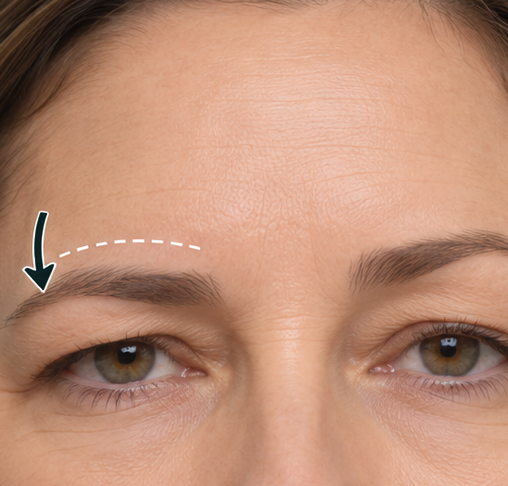
Brow Ptosis
The eyebrow sits lower than its natural position, allowing tissue above the eyelid to crowd the upper-eye area. A brow lift may be appropriate when brow descent is the primary problem.
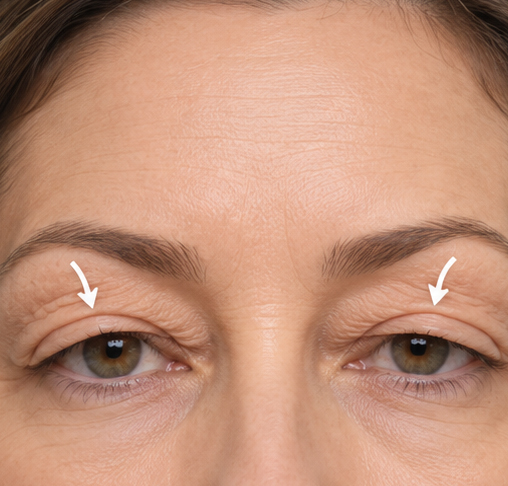
Dermatochalasis
Excess upper eyelid skin creates folds and hooding even when the eyebrow is appropriately positioned. Upper blepharoplasty may address the redundant skin.
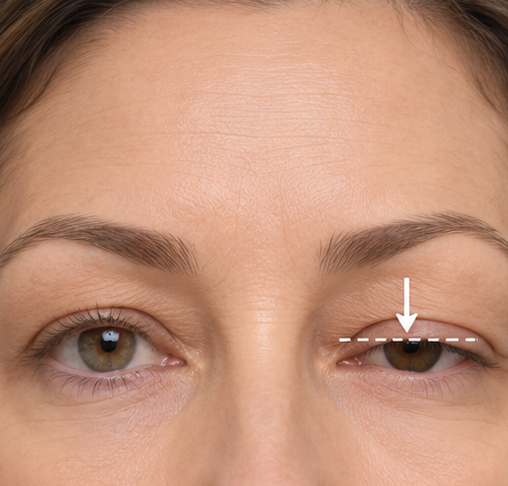
True Eyelid Ptosis
The upper eyelid margin itself sits too low, potentially affecting the visible opening of the eye. Correcting this may require ptosis repair rather than skin removal alone.
These conditions can also occur together. That’s why I examine the position of the brow, the amount of eyelid skin and the movement of the upper eyelid before recommending surgery.
What If the Eyelid Itself Is Sitting Too Low?
There is another condition that can make the upper eyes look heavy, and it is important not to confuse it with loose eyelid skin or a low eyebrow. True eyelid ptosis, also called blepharoptosis, occurs when the upper eyelid margin itself sits lower than it should.
The distinction matters because removing excess skin does not necessarily correct an eyelid that is positioned too low. The problem may involve the muscles or supporting structures responsible for elevating the upper lid. A patient can also have true ptosis and excess eyelid skin at the same time.
When I examine the eyes, I pay attention to the upper eyelid margin, symmetry between the two sides and how well the eyelid elevates. If ptosis is present, it needs to be evaluated as a separate part of the treatment plan. Some patients may require a specific ptosis correction rather than blepharoplasty alone.
For a broader discussion of conditions that cause heavy or drooping upper eyes, our droopy eyelids page explains the available treatment considerations.
Sudden or newly developed eyelid drooping is a different situation from gradual cosmetic aging and deserves prompt medical evaluation, particularly when accompanied by double vision, unequal pupils or neurological symptoms.
Why Some Patients Need Both a Brow Lift and Upper Blepharoplasty
Not every patient fits neatly into one category. Some have a genuinely lowered brow along with excess upper eyelid skin. In those patients, correcting just one problem may leave part of the heaviness behind.
I begin by determining how much of the upper-eye crowding comes from the brow. If I reposition the brow to an appropriate location and significant excess eyelid skin remains, that tells me the eyelid also needs attention.
The amount of eyelid skin I would remove can change when I account for the planned brow position. That’s why I want to evaluate these operations together, even when I ultimately recommend only one of them.
I’ve treated patients with a combination of brow lifting and upper blepharoplasty when both were needed. In one patient’s upper-face rejuvenation, I combined brow lifting with upper eyelid surgery and adjusted the eyelid approach around the change in brow position. The goal was to preserve the natural appearance of her eyes while correcting the underlying concerns.
That doesn’t mean combined surgery is automatically better. If one procedure can accomplish the result a patient wants, I don’t need to recommend two. My surgical plan should reflect the anatomy rather than a standard package of procedures.
I don’t decide whether you need a brow lift or blepharoplasty based only on how much skin appears to be hanging over your eyes. I want to understand what happens to that skin when the eyebrow is placed where it belongs.
How I Determine Which Surgery Makes Sense for You
When someone comes to me concerned about tired-looking eyes, I start by having them show me what they dislike. I want to know whether they’re concerned about the outer corners, the skin over the eyelid crease or the position of the eyelid itself.
Then I examine the relationship between the forehead, brow and upper eyelid with the facial muscles relaxed. I look at how the brows sit on each side, whether the forehead is compensating for heaviness, and how much eyelid skin remains when the brows are supported at an appropriate position.
I also evaluate eyelid closure, the position of the eyelid margin and any relevant eye symptoms or medical history. Prior photographs can be useful because they show a patient’s natural brow shape and eyelid anatomy before aging-related changes occurred.
One of the most important parts of this process is understanding what the patient considers a successful result. Some want the upper eyelid crease to be more visible. Others want the outer part of the eye to feel less crowded. I need to understand that difference before recommending an operation.
Patients may also ask whether the procedure will change their eye shape. My goal is usually to restore a refreshed appearance without making the person look surprised or altering facial features they want to preserve. That requires careful planning, especially when combining a brow lift with upper eyelid surgery.
SEE THE RESULTS
What to Look for in Brow Lift and Blepharoplasty Photographs
Before and after photographs can help illustrate how different surgical approaches change the upper-eye area. I recommend looking at the position of the brows as well as the amount of skin visible above the eyelashes. Pay attention to whether the eyes look naturally open rather than simply wider.
The following examples are drawn from our eyelid surgery gallery and brow lift gallery. They include isolated upper blepharoplasty, combined brow and eyelid surgery, and a patient who underwent ptosis repair. Some patients had additional facial procedures, so their results should not be attributed to the brow or eyelid operation alone.
These photographs aren’t intended to suggest that everyone needs the same amount of correction. They demonstrate why identifying the underlying problem is more important than choosing a procedure simply because you like the result in someone else’s photograph.
BEFORE & AFTER
Brow Lift & Eyelid Surgery Results


Why I Don’t Want to Make Every Patient’s Eyes Look the Same
One of the things I try to avoid is giving someone a surgically altered look when all they wanted was to appear more rested. The relationship between the brow and upper eyelid contributes a great deal to a person’s natural expression, so changing that relationship needs to be done thoughtfully.
A brow that’s elevated too much can make someone appear surprised. Removing too much upper eyelid tissue can create an unnaturally hollow appearance or interfere with eyelid closure. Neither is the result I’m trying to achieve.
Sometimes a relatively small correction is all that is necessary. In another patient, combining procedures may provide a more balanced improvement because both the brow and eyelid are contributing to the heaviness. The goal is to make the appropriate correction rather than the most extensive one.
For patients who are primarily concerned about loose eyelid skin, our upper eyelid surgery page provides more detail about that procedure. Those who want to understand the different brow-lifting approaches can review our brow lift page. The existing article on hooded eyelids and their treatment also explains the broader range of possible causes and options.
MY FINAL THOUGHT
Choosing the Right Surgery Begins With Finding the Real Problem
If your eyes look tired, I don’t want you to assume that removing eyelid skin is automatically the answer. I want to see what happens when your forehead relaxes, where your brows naturally sit and whether excess skin remains after accounting for brow position.
If the problem is primarily in the eyebrow, lifting it appropriately may provide the improvement you’re looking for. If the problem is truly excess upper eyelid skin, blepharoplasty may be the better operation. When both contribute, I can evaluate whether a combined approach makes sense.
The most important thing is recognizing what needs to change before choosing how to change it. That’s how I approach upper-face rejuvenation, and it’s how I help patients understand what surgery can reasonably accomplish for their individual anatomy.
FREQUENTLY ASKED
Questions About Brow Lifts and Upper Blepharoplasty
These are some of the questions I discuss with patients who are deciding whether their heavy upper-eye appearance is best addressed through brow lifting, eyelid surgery or a combination of procedures.
How can I tell whether I need a brow lift or upper blepharoplasty?
I begin by evaluating where the heaviness originates. If your eyebrows have descended and are pushing tissue toward the eyelids, a brow lift may be appropriate. If the brow is well positioned but excess upper eyelid skin remains, upper blepharoplasty may provide the correction you need. Both problems can also occur together. A published review of upper blepharoplasty and brow lifting emphasizes evaluating brow position, eyelid skin and true eyelid ptosis separately before choosing surgery. The mirror test can provide a clue, but I make the recommendation after examining the full upper-eye area.
Will upper blepharoplasty lift my eyebrows?
No. Upper blepharoplasty is intended to address the eyelid tissues rather than elevate the eyebrow. Brow position can change after eyelid surgery, but I do not rely on blepharoplasty to provide a brow lift. A systematic review and meta-analysis of brow position after upper eyelid surgery found that brow height decreased on average across the studies analyzed, although individual changes varied. This is one reason I evaluate the brow before planning how much eyelid skin to remove.
Can I have a brow lift and upper blepharoplasty at the same time?
Yes. When a patient has both brow descent and genuine excess upper eyelid skin, combining the procedures may provide a more complete correction. However, I don’t automatically recommend both operations. A 2024 study of upper eyelid rejuvenation procedures included patients treated with upper blepharoplasty alone and others who underwent additional brow lifting or ptosis correction. The appropriate combination depends on the specific findings of the examination.
Do forehead wrinkles mean my eyebrows are drooping?
Not necessarily. Forehead lines can develop through ordinary facial expression and changes in skin elasticity. Some patients, however, repeatedly contract the frontalis muscle to elevate heavy brows or compensate for drooping eyelids. The clinical literature on upper-face aging and eyelid evaluation describes the importance of identifying compensatory brow elevation during the examination. I look at what happens when the forehead relaxes rather than assuming the wrinkles themselves indicate a need for surgery.
Can upper blepharoplasty correct a truly drooping eyelid?
It depends on what is causing the drooping. If excess upper eyelid skin is the main concern, blepharoplasty may help. But true eyelid ptosis occurs when the upper eyelid margin itself sits too low, which may require a different surgical correction. In a study examining upper blepharoplasty with and without ptosis repair, some patients required correction of the eyelid’s lifting mechanism in addition to skin removal. That’s why I check eyelid margin position and function rather than treating every heavy upper eyelid as excess skin.
Will a brow lift change the shape of my eyes?
A brow lift can change how open the upper-eye area appears because it repositions the tissues above the eyelids. That can influence the visible eyelid crease and the way the outer brow frames the eye. My goal is to restore an appropriate brow position while preserving your natural expression. A clinical review of brow and upper eyelid rejuvenation discusses the importance of brow shape and careful surgical planning to avoid an exaggerated or surprised appearance. The amount of correction should be individualized rather than based on a standard brow height.
Why might my brows look different after upper eyelid surgery?
Some patients habitually elevate their brows to compensate for heavy upper eyelids. After the eyelid skin is corrected, that compensatory muscle activity may change. Brow position after surgery can also vary according to the technique used and individual anatomy. A 2024 study comparing upper blepharoplasty alone with blepharoplasty combined with internal browpexy reported differences in postoperative brow position between the groups. This is another reason I evaluate brow position as part of the surgical plan, even when a patient initially requests only eyelid surgery.