A double chin is not always a weight problem. Some people have a pocket of fat under the chin despite being at a stable weight. Others have loose skin, a weak chin or deeper neck anatomy that makes the area look full even when there is very little fat to remove.
When someone asks me about chin liposuction, I start by determining which of those problems is actually present. If the fullness is mainly superficial fat and the skin has enough elasticity to settle after it is removed, liposuction may be a good option. But removing fat cannot correct every reason a jawline looks soft.
This is where I want patients to understand the anatomy before choosing a procedure. Chin liposuction, sometimes called submental or neck liposuction, is useful for a specific problem. A neck lift or a procedure addressing chin projection may be better suited to a different one.
I do not decide whether you need chin liposuction by looking at the size of your double chin. I decide by looking at what is creating that fullness.
THE PROCEDURE
What Is Chin Liposuction, and What Does It Actually Remove?
Chin liposuction removes selected deposits of fat from the area underneath the chin and along the upper neck. The medical term submental refers to the region directly below the chin. The goal is to improve the transition between the underside of the jaw and the front of the neck, not simply to make the entire lower face smaller.
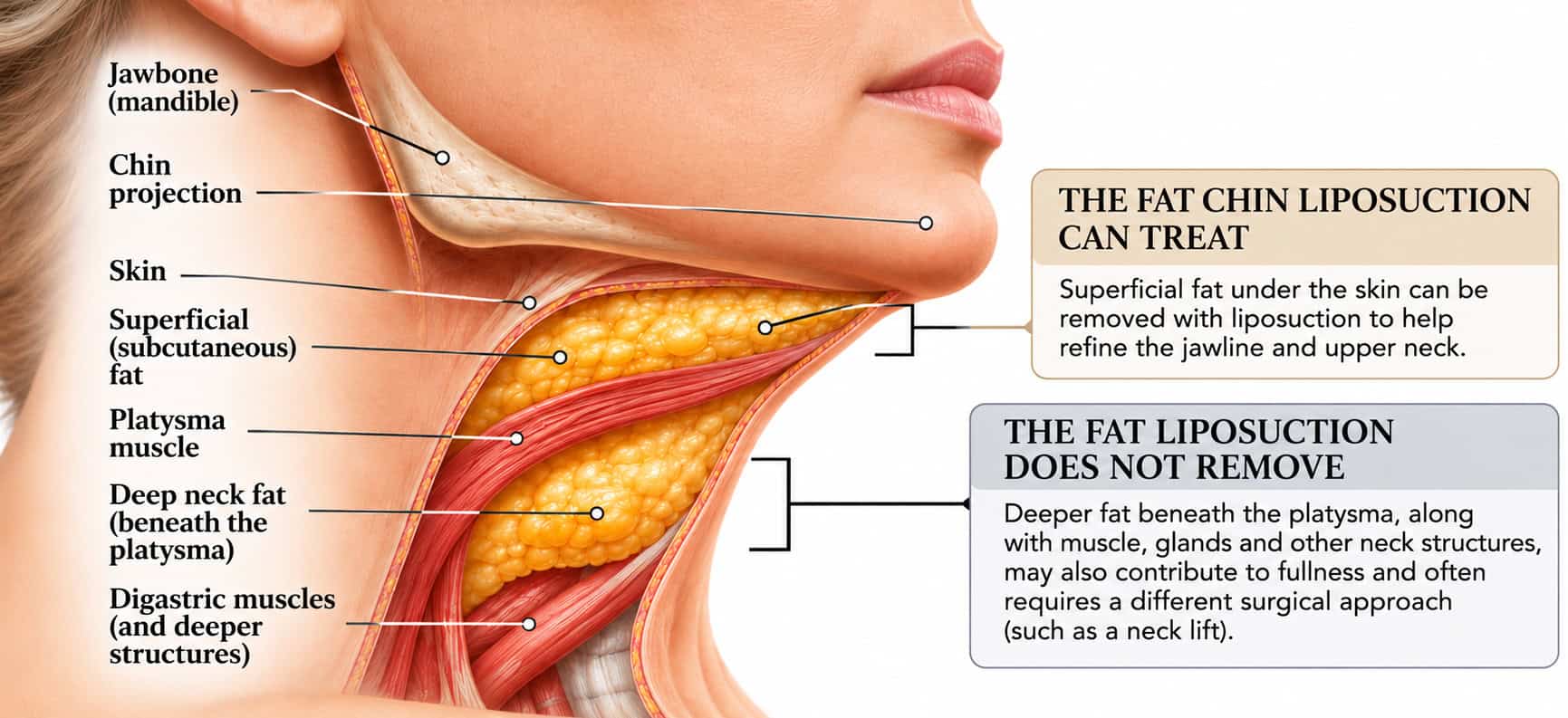
The important anatomical point is where that fat sits. The neck contains skin, a layer of superficial fat, a thin sheet of muscle called the platysma and deeper structures beneath that muscle. Standard liposuction works primarily on the accessible fat superficial to the platysma. It does not substitute for direct surgical treatment of deeper neck fat, muscles or prominent glands.
When a patient has a localized pocket of superficial fat, good skin elasticity and relatively little neck muscle laxity, removing some of that fat may be enough to reveal a cleaner contour. That is the kind of patient in whom I consider liposuction alone.
WHO BENEFITS MOST
Who Is a Good Candidate for Chin Liposuction?
I am most interested in the quality of the skin and the location of the fat. Age can influence both, but it is not the deciding factor. A younger patient may have considerable fullness caused by structures that liposuction will not correct. An older patient may still have enough skin elasticity for a limited procedure, depending on the examination.
Localized Fat Beneath the Chin
If the main problem is a distinct pocket of superficial fat, chin liposuction can be an efficient way to reduce it. This can be related to genetics and natural fat distribution as well as changes in body weight. Being otherwise lean does not rule out a localized submental fat deposit.
Skin That Can Contract After Fat Removal
Removing fat creates less volume under the skin. The remaining skin then has to settle over the new contour. If it is elastic and there is little preexisting laxity, that adjustment may be satisfactory. If the skin already hangs loosely, reducing the fat underneath can leave a contour that looks deflated or irregular rather than sharply defined.
Good Neck Support and Realistic Goals
I examine the platysma, the jawline, chin projection and position of the deeper structures. If the neck muscle is relatively well supported and there is not significant jowling or skin descent, liposuction is more likely to match the concern the patient wants corrected.
I also ask about weight stability, previous neck surgery, overall health and recovery expectations. Liposuction is a contouring procedure, not a treatment for obesity or a guarantee of a particular jawline shape.
ANATOMY BEYOND FAT
Why Chin Liposuction Does Not Fix Every Double Chin
I see patients who are frustrated because they are at a healthy weight but still have a rounded, poorly defined neck. They assume there must be fat that needs to come out. Sometimes there is. Other times the fullness comes from a structure underneath the muscle, and liposuction would barely change it.
1. Loose Skin and Platysmal Bands
With age and individual tissue changes, the skin can become less elastic and the platysma can loosen or form visible vertical bands. Liposuction does not reposition that muscle or remove redundant skin. When laxity is the dominant problem, a procedure designed to support the neck tissues is more appropriate.
2. Fat Beneath the Platysma
Some fat is located deeper in the neck, below the platysma muscle. It contributes to fullness, but it is not the same fat that a standard superficial liposuction cannula is intended to remove. Addressing that layer requires a different surgical approach. My neck lift page explains why I differentiate superficial fat removal from deeper neck contouring.
3. Prominent Neck Muscles or Submandibular Glands
The digastric muscles and submandibular salivary glands also contribute to the shape below the jaw. In selected patients these structures are more prominent, and simply suctioning away superficial fat will not flatten them. I assess their position and whether they are actually contributing to the contour before discussing a deeper procedure.
4. A Recessed Chin
Sometimes the neck is not particularly heavy. Instead, the chin sits farther back, making the transition from chin to neck appear shorter and less defined. Removing fat will not change the position of the underlying bone. For that patient, discussing a weak or recessed chin and the available augmentation options may be more useful.
5. The Position of the Hyoid Bone
The hyoid is a small bone suspended in the upper neck. Its position helps shape the angle between the chin and throat. A lower or more forward hyoid can limit how sharp that angle appears, even after fat reduction or neck surgery. I discuss this anatomy in more detail in my article on hyoid position and neck contour.
Removing more fat is not the solution to every heavy neck. If the fullness is underneath the muscle, in the skin or in the underlying skeletal shape, I need to address that specific anatomy.
Chin Liposuction vs. Neck Lift: How I Choose
Patients sometimes use the terms interchangeably because both procedures can improve the area beneath the jaw. Surgically, they are different.
Chin Liposuction
I consider this when the main concern is removable superficial fat, with good skin contraction and little muscle or skin laxity. The procedure is limited to fat removal and relies partly on the patient’s tissues to redrape afterward.
Deep Neck Lift
A deep neck lift is appropriate in selected patients whose fullness comes from deeper fat, muscle anatomy or other structures beneath the platysma. It involves direct surgical contouring, not just suctioning superficial fat. A patient can be relatively young and still need deeper contouring if that is where the fullness originates.
Neck Lift With Skin and Muscle Repositioning
If there is substantial skin laxity, platysmal banding or descent along the lower face, I may need a neck lift or a face and neck lift that addresses these structures. Liposuction alone will not resuspend tissues that have descended or remove significant excess skin.
A patient with true jowls may need a different assessment from someone with fat directly under the chin. I explain that lower-face distinction in my article on jowls and their causes.
DR. ATHRÉ EXPLAINS
Why Neck Fullness Sometimes Requires More Than Liposuction
Dr. Athré demonstrates deep-neck anatomy and a patient treated with a deep neck lift. This is not an isolated chin-liposuction result. It illustrates why removing superficial fat alone would not accomplish the same correction in that patient.
WHAT SURGERY INVOLVES
How Is Chin Liposuction Performed?
For an appropriately selected patient, chin liposuction is performed through small skin incisions that provide access to the fat beneath the chin and, when needed, along the upper neck. An incision inside the mouth is not the standard approach for suctioning submental fat.
On my neck lift page, I describe using a tumescent solution to numb the tissues and reduce bleeding, followed by a small blunt-tipped cannula to remove the planned fat. The precise access points, anesthesia and extent of treatment depend on the patient’s anatomy and the surgical plan.
I want an even transition across the neck, not an abrupt hollow directly under the chin. That means removing the appropriate amount of fat while respecting the thickness of the remaining layer and the contour of the jaw.
Some cases can be performed with local anesthesia, sometimes with additional sedation. Other patients may be having a combined procedure that calls for a different anesthetic plan. I review those decisions individually rather than promising that every chin-liposuction patient will have exactly the same experience.
HEALING AND RESULTS
What Is Recovery Like After Chin Liposuction?
Swelling, bruising, tenderness and temporary firmness are common after submental liposuction. The neck can look puffy or uneven before the swelling settles, which is why an early photograph does not tell the whole story.
Depending on the extent of treatment, I may recommend compression and restrictions on strenuous exercise during early healing. Incision care, activity instructions and follow-up appointments are individualized. Patients should follow their own postoperative directions instead of applying someone else’s recovery timeline to their surgery.
When Will the Jawline Look More Defined?
Some improvement may become visible relatively early, but refinement continues as swelling and firmness resolve and the skin settles over the treated region. I would not evaluate the final contour after only a few days. Patients also differ in how their skin contracts, so the result cannot be judged by fat removal alone.
Can the Double Chin Come Back?
Fat cells removed during liposuction are not expected to regenerate in the same way, but remaining fat cells can enlarge if body weight increases. Aging, skin laxity and changes in deeper neck support can also alter the contour over time. I do not present liposuction as a procedure that permanently stops the neck from changing.
What Are the Risks of Chin Liposuction?
Although chin liposuction is less extensive than many neck-lifting procedures, it is still surgery. Along with swelling and bruising, possible problems include bleeding, infection, fluid collections, temporary or persistent numbness, asymmetry, uneven fat removal, contour irregularities and scar-related firmness. Injury to nearby structures is uncommon but must be considered during surgical planning.
There is also an aesthetic risk: removing fat without assessing the skin and deeper neck can make the result less attractive rather than more defined. A patient with significant skin laxity may be left with loose skin, while aggressive removal in a patient with little fat can create visible depressions.
One reason I spend time examining the neck before recommending liposuction is that the risk of a poor contour is not only about surgical technique. It is also about whether we chose the correct procedure for the anatomy.
COST AND PLANNING
How Much Does Chin Liposuction Cost?
The cost depends on whether liposuction is performed alone or as part of a more comprehensive neck or facial procedure, along with anesthesia, facility fees and surgical complexity. There is no single price that fairly describes every patient asking about a double chin.
Our pricing structure page explains how surgical estimates are organized. Because the published guide does not specify a standalone chin-liposuction price, I would rather provide an individualized quote after examining your neck than suggest a number that may not match the treatment you actually need.
Chin liposuction performed for cosmetic contouring is generally not covered by health insurance. If there is a separate medical concern, its evaluation and coverage are distinct questions for your medical team and insurer.
How I Decide Whether Chin Liposuction Is Enough
When I examine a patient who wants a sharper jawline, I start by looking at the neck in profile and from the front. I assess how much superficial fat is present, how the skin and platysma behave, whether deeper structures contribute to fullness and how the chin projects relative to the neck.
If the answer is a localized fat pocket with good skin support, liposuction may be all that is needed. If the fullness is deeper, or if there is substantial laxity or a recessed chin, I explain why another approach may produce a better result.
I want to remove fat when fat is the problem. When it isn’t, I want to be able to tell you that before you undergo a procedure that cannot deliver the change you are hoping for.
FREQUENTLY ASKED
Questions About Chin Liposuction and Double-Chin Surgery
These questions cover when submental liposuction is appropriate, what it cannot treat, and how recovery, risks and cost affect the decision.
Does chin liposuction actually work for a double chin?
Yes, when the main source of fullness is accessible superficial fat and the skin has enough elasticity to settle afterward. It is less effective for deep fat, excess skin or muscle-related neck fullness. A clinical study of anterior neck rejuvenation distinguishes patients who can benefit from liposuction alone from those who need deeper contouring or skin treatment.
Is chin liposuction the same as a neck lift?
No. Chin liposuction removes selected fat under the chin. A neck lift may also address platysmal muscle laxity, deeper fat, loose skin or other structures. A review comparing submental liposuction and formal cervicoplasty explains why isolated liposuction is appropriate for a narrower group of patients.
Will the skin tighten after chin liposuction?
Some skin contraction may occur, but the extent depends heavily on skin quality and existing laxity. Liposuction does not replace removing redundant skin or repositioning loose muscle. A clinical discussion of neck contour and skin elasticity identifies skin quality as an important factor in how well the neck can redrape without skin excision.
Can chin liposuction remove fat underneath the neck muscles?
Standard liposuction primarily treats the superficial fat layer. Deeper fat beneath the platysma requires separate surgical assessment and, when appropriate, direct treatment. A review of aging-neck anatomy describes the superficial, muscular and deep planes that must be distinguished in surgical planning.
Can I have a double chin even if I am not overweight?
Yes. Fat distribution, skin quality, muscle anatomy, gland prominence, hyoid position and chin projection all influence the contour under the jaw. A review of anatomic neck-lift planning emphasizes that submental fullness can have several causes beyond superficial fat.
Can chin liposuction improve a weak or recessed chin?
It can improve the definition beneath the jaw when superficial fat is obscuring the contour, but it does not increase chin projection. Some patients need an assessment for chin augmentation rather than, or in addition to, fat removal. The review of neck-contouring anatomy supports evaluating multiple structural contributors before selecting a procedure.
How long does recovery take after chin liposuction?
Recovery varies with the extent of treatment, but swelling, bruising, tenderness and temporary firmness are expected early on. The final contour takes longer to settle than the initial return to everyday activity. The 2026 systematic review of submental liposuction complications also highlights the need for follow-up because contour issues and fluid collections can appear during healing.
What are the possible risks of submental liposuction?
Possible risks include bleeding, infection, swelling, fluid collections, asymmetry, contour irregularities and nerve or tissue injury. In a systematic review of adverse events after submental liposuction, reported problems included seromas, surface irregularities and platysmal banding. The study also noted important limitations in the evidence used to estimate complication rates.
How much does chin liposuction cost?
The price depends on the anatomy, the type and extent of surgery, anesthesia and facility fees. Athré Facial Plastics does not publish a standalone chin-liposuction price in its current guide. The pricing structure explains the fee categories, and an individualized estimate is provided after consultation.


