
Sometimes a patient can have a well-defined jawline after a facelift or neck lift and still see a small area of fullness immediately beneath it. That fullness is not always fat or loose skin. In some patients, the submandibular gland itself is contributing to the contour.
Tightening tissue over a prominent deep structure does not make that structure disappear. But that does not mean every patient needs submandibular gland reduction. When I evaluate someone for a neck lift, I look at the gland as one part of the deeper neck anatomy and address it selectively when I believe it will interfere with the contour I am trying to create.
What Is the Submandibular Gland?
The submandibular glands are a pair of major salivary glands located beneath the lower jaw. They normally sit deep within the upper neck and contribute to saliva production.
From a facial rejuvenation standpoint, the important issue is not simply that the glands are there. It is where they sit relative to the jawline and the contour of the neck.
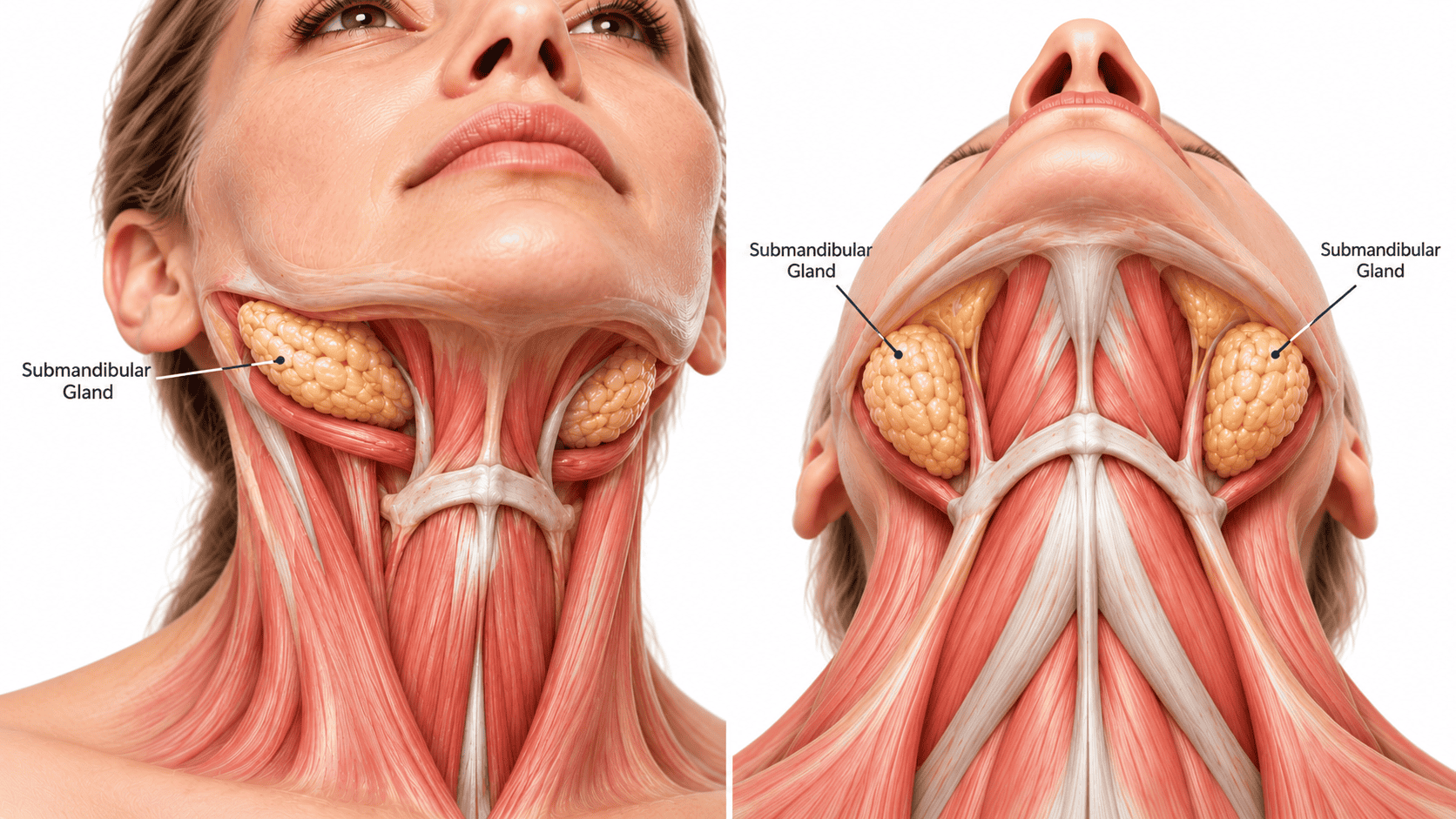
In some patients, a gland is positioned or becomes prominent enough that it creates visible fullness beneath the mandible. Surgical literature on neck rejuvenation recognizes the submandibular gland as one of several deep structures that can contribute to submandibular fullness, along with deep fat and the digastric muscles.
INSIGHTS FROM DR. ATHRÉ
Why the Submandibular Gland Can Affect the Jawline
Dr. Athré explains where the submandibular gland sits, how he evaluates its relationship to the jawline and why he reduces it only in selected patients.
How a Prominent Gland Can Create a “Double Bubble”
When the jawline becomes more defined but the gland remains prominent beneath it, you can sometimes see two separate contours: the jawline above and a secondary bulge below. I often describe this as a “double bubble.”
This can be particularly noticeable in slender patients with relatively thin neck tissues because there is less tissue concealing the deeper anatomy. In a thicker neck, the same gland may have much less influence on the visible contour.
This is also why I do not assume that fullness beneath the jaw is simply fat. Skin, superficial and deep fat, platysma, digastric muscle, skeletal anatomy and the submandibular glands can all influence the appearance of the neck.
The question is not, “Do I remove the gland during a facelift?” The question is, “Is this gland actually contributing to the contour I am trying to correct?”
Why a Facelift or Neck Lift May Not Correct Gland Prominence
A deep plane facelift can reposition descended facial tissues, while deep neck surgery can address laxity and other structures beneath the jaw. But neither operation automatically makes a prominent submandibular gland disappear.
If a deep structure is creating part of the visible fullness, tightening the tissues around it may actually make its contour easier to see. This is one reason I evaluate the neck structurally rather than thinking of neck rejuvenation as simply removing fat and tightening skin.
The medical literature takes a similar anatomical approach. Reviews of deep neck surgery describe the submandibular gland as one of several structures that may need to be considered when treating fullness beneath the jaw.
How I Evaluate the Submandibular Gland
One concept I use is an imaginary line extending from the lower border of the mandible toward the hyoid region. I look at where the gland sits in relation to the neck contour I am trying to create.
If the gland projects below that desired contour, it may be contributing to the fullness beneath the jaw. That does not automatically mean I reduce it. It tells me that the gland needs to be considered along with everything else I see in the neck.
I also consider the patient’s skin thickness, neck thickness, skeletal anatomy and the other structures contributing to the contour. Two people can have very similar concerns when they look in the mirror and require very different operations.
What Selective Submandibular Gland Reduction Means
In aesthetic neck surgery, gland reduction generally refers to reducing the portion of the gland contributing to unwanted contour rather than treating every gland the same way.
This is a selective decision. I do not believe every patient undergoing a facelift should have the glands reduced, and I do not believe they should automatically be left alone in every patient.
My 4D Facelift™ is based on the same broader principle. Facial aging is not one problem. The operation should be built around the anatomical changes that are actually present rather than applying the same combination of maneuvers to everyone.
BEFORE & AFTER
Jawline and Neck Contour After Surgery


Why Deep Neck Anatomy Matters
Submandibular gland reduction means operating in a compact area containing important nerves, blood vessels and salivary structures. This is not simply another form of fat removal.
Before specializing in facial plastic surgery, Dr. Raghu Athré trained in head and neck surgery. That background influences how I evaluate the deeper structures of the neck and my comfort working in this anatomy when I believe doing so is appropriate.
There is genuine variation among surgeons in how the submandibular gland is managed. Some rarely address it, while others incorporate gland reduction more frequently into deep neck surgery. The published literature also reflects differences in patient selection, operative technique and reported complication rates.
For me, that reinforces the importance of individual anatomy rather than supporting an absolute rule in either direction.
What Are the Risks of Submandibular Gland Reduction?
Submandibular gland reduction has risks that deserve to be discussed separately from the more familiar risks of facelift and neck lift surgery.
Published reports describe complications including bleeding or hematoma, temporary weakness involving the marginal mandibular nerve, saliva collection or sialocele, and other salivary or nerve-related problems. The reported rates vary substantially among studies and surgical techniques.
A 2015 series of 112 aesthetic gland reductions reported sialocele and temporary marginal mandibular nerve weakness among the more frequent gland-specific complications. More recent reviews continue to emphasize careful patient selection, detailed anatomical knowledge and appropriate surgical technique.
This is why I would not describe gland reduction as either inherently necessary or risk-free. The potential improvement has to justify taking on the additional surgical anatomy and risk in that particular patient.
Recovery After Deep Neck Surgery
Recovery depends on the entire operation being performed, not simply whether the submandibular gland was addressed. A patient having gland reduction as one component of a comprehensive facelift and deep neck lift will have a different recovery from someone undergoing a more limited procedure.
Because the gland produces saliva, I give specific postoperative instructions intended to reduce salivary stimulation during the early healing period. I also monitor for swelling or fluid collection that could indicate a salivary issue or another postoperative problem.
The broader facelift recovery process includes swelling, bruising and progressive changes in contour as the tissues heal. Early photographs should never be mistaken for a final result.
FREQUENTLY ASKED
Submandibular Gland Reduction FAQs
Submandibular gland reduction is a specialized part of deep neck surgery, and it is not appropriate for every patient. These are some of the questions I hear most often.
Does everyone having a deep plane facelift need submandibular gland reduction?
No. I consider gland reduction only when the gland is contributing meaningfully to the contour beneath the jaw. A 2026 systematic review of submandibular gland reduction likewise describes the procedure as an adjunct for selected patients rather than a universal component of facelift surgery.
Can a prominent submandibular gland look like neck fat?
It can contribute to fullness in the same general area, which is why determining the anatomical source matters. A review of the deep structures involved in neck contour identifies the submandibular gland, deep fat, digastric muscle and other structures as potential contributors to submandibular fullness.
What is the “double bubble” beneath the jawline?
It is a descriptive term I use for a secondary area of fullness beneath a defined jawline. A prominent submandibular gland can be one cause. It is not a diagnosis by itself, and the underlying anatomy has to be evaluated before deciding what is creating the contour.
Is the entire submandibular gland removed?
In aesthetic neck surgery, published techniques commonly describe partial or selective reduction rather than routine complete gland removal. A systematic review of partial submandibular gland resection evaluated this approach specifically in patients undergoing aesthetic neck surgery.
Will reducing the gland cause dry mouth?
Saliva is produced by several major and minor salivary glands, and salivary output changes with stimulation. Published aesthetic series have not consistently reported permanent dry mouth after partial reduction, but that should not be interpreted as proof that salivary symptoms are impossible. Salivary physiology is more complex than the function of a single gland, and the potential functional risks should be discussed before surgery.
What is a sialocele?
A sialocele is a collection of saliva that can develop when saliva leaks into the surrounding tissues during healing. It is a recognized complication of submandibular gland surgery. In a 112-patient aesthetic gland-reduction series, sialocele occurred in a minority of patients and resolved with treatment.
What nerves are important during submandibular gland reduction?
The gland lies near important neural structures, including the marginal mandibular branch that contributes to lower-lip movement. Temporary lower-lip weakness has been reported after gland reduction. A review of submandibular gland management in neck lifts emphasizes the need for advanced knowledge of the subplatysmal anatomy.
Can submandibular gland prominence matter in revision facelift surgery?
Yes. Persistent fullness or gland ptosis can be among the anatomical issues evaluated during revision neck surgery. A systematic review of revision neck lift surgery identified submandibular gland ptosis among reported indications for revision, although the available evidence remains limited.
How do you decide whether the gland should be reduced?
I look at the entire neck rather than making the decision from one structure alone. That includes the position of the gland, the contour beneath the mandible, skin and neck thickness, fat, muscle, skeletal anatomy and the other changes being treated. The goal is not to perform the most surgery possible. It is to address the structures that are actually responsible for the contour.