When people think about facial plastic surgery, they often picture women. But men have many of the same concerns about their appearance. They notice heavy eyelids, changes in the jawline, loose skin around the neck, or a nose they have never particularly liked. The difference is often not why they want surgery, but what they want the result to look like.
In my practice, men represent a smaller percentage of surgical patients than women, but I have some very interesting conversations with them. Many are not looking for a dramatic transformation. They want to look less tired, restore definition to their face, or correct something that has bothered them for years. Just as importantly, they want the result to look like them.
That last point matters because male facial surgery requires careful attention to anatomical features that contribute to a masculine appearance. The position of the eyebrows, shape of the eyelids, strength of the jawline, proportions of the nose, and even the placement of a beard or sideburn can influence how I plan an operation.
I am not trying to make a man look like a younger version of someone else. I want to improve the features that bother him while preserving the characteristics that make his face recognizable.
CHANGING PERCEPTIONS
Why Are More Men Open to Facial Plastic Surgery?
I think part of the change is that men are more comfortable discussing appearance-related concerns than they were in the past. There was a time when many men considered cosmetic treatments something exclusively for women. Today, that distinction is becoming less meaningful. Men take care of their skin, pay attention to fitness and nutrition, and increasingly recognize that facial aging is something they can choose to address.
That does not mean every man wants to look younger. Sometimes the concern is simply that his appearance no longer reflects how he feels. A man in his 50s may be active, healthy and energetic, but heavy upper eyelids make him look constantly tired. Another may have maintained his weight for years but developed loose skin and fullness beneath the chin that will not improve with exercise.
For some men, professional life is part of the motivation. They spend their days meeting clients, leading teams or appearing on video calls, and they have become more conscious of how their face looks. Others are motivated by a personal milestone, a relationship or a long-standing concern they finally have the opportunity to address.
I do not think one motivation is inherently better than another. What matters is that the decision comes from the patient, the goals are realistic, and the proposed procedure can actually address the concern.
SURGICAL PLANNING
Why Is Facial Plastic Surgery Different for Men?
Male and female faces share the same basic anatomy, but there are important differences in average proportions, tissue thickness, hair distribution and aesthetic expectations. These differences are not absolute rules. Every patient has individual features, and some men have naturally softer facial proportions while others have more angular characteristics.
Still, these anatomical differences can influence how I perform surgery. Male facial skin is often thicker, and men may have more substantial underlying muscle and vascularity. Hair-bearing skin also introduces considerations that are less prominent in patients without facial hair, particularly when planning facelift incisions around the ears and sideburns.
There are also differences in how certain features are typically perceived. A relatively low, straight eyebrow may look completely natural on a man, while a more elevated and arched brow may be desirable for some women. A strong nasal bridge or a more angular jawline may contribute to the appearance a male patient wants to preserve.
What I want to avoid is applying an aesthetic standard developed for one type of face to every patient. Removing too much upper eyelid skin, elevating the eyebrows excessively or making the nose disproportionately small can change facial character in ways the patient never wanted.
That is why the consultation matters. Before I recommend a procedure, I need to understand which features the patient wants to change and which features he wants to keep.
Successful male facial surgery is not simply about tightening skin or removing tissue. It is about creating improvement without changing the fundamental character of the face.
MALE EYELID REJUVENATION
Why Eyelid Surgery Is a Common Choice for Men
One of the procedures I frequently discuss with male patients is blepharoplasty, or eyelid surgery. The eyes have an enormous influence on how we interpret someone’s expression. Heavy upper eyelids can make a person look tired, while prominent lower eyelid bags can create an appearance of fatigue even when the patient feels perfectly rested.
In some patients, excess upper eyelid skin becomes significant enough to interfere with the upper field of vision. That changes the conversation because the problem may involve function as well as appearance. I also examine the position of the eyebrows and the actual eyelid margin to determine whether the concern is excess skin, brow descent, true eyelid ptosis or a combination of factors.
For men, I generally approach the upper eyelids conservatively. I want to improve the heaviness without creating an unnaturally high eyelid crease or removing so much tissue that the eye looks hollow. The same principle applies to the lower eyelids, where I evaluate fat distribution, skin excess and eyelid support before deciding which technique is appropriate.
Chris’s Experience With Male Eyelid Surgery
Chris is a patient who gives me a useful example of what men are actually looking for. He came to see me because he had inherited heavy upper eyelids that were becoming increasingly bothersome. He told me that people frequently asked whether he was tired, even when he had slept well. The heaviness was also beginning to interfere with his peripheral vision and made inserting contact lenses difficult.
We performed upper and lower eyelid surgery under local anesthesia with oral sedation. In our conversation approximately one month later, Chris discussed his experience, including the anxiety he felt before surgery, the early recovery period and how he followed his postoperative instructions.
One of the things I explained to Chris was why I had deliberately avoided making certain changes that I might consider for a different patient. I did not want to elevate his eyebrows unnecessarily or create an eyelid appearance that seemed out of place on his face. His goal was to open his eyes and look less tired, not to change his identity.
That is an important distinction. When Chris described his result, he said his eyes looked normal to him, without the heavy upper lids that had bothered him before. That is exactly the kind of conversation I want to have with a male patient: what is bothering you, and how can we improve it without making you look different in an unintended way?
REAL PATIENT EXPERIENCE
Chris Discusses His Male Eyelid Surgery
Chris describes why he wanted upper and lower eyelid surgery, how he experienced the procedure under local anesthesia with oral sedation, and what recovery was like. I also explain why planning male eyelid surgery requires particular attention to natural brow position and eyelid contours.
FACIAL REJUVENATION FOR MEN
What Is Different About a Male Facelift?
When men come to see me about facial aging, the jawline and neck are often major concerns. They may notice that the once-defined transition between the jaw and neck has become less distinct. Jowls have developed, the skin beneath the chin has loosened, or the neck has become fuller despite maintaining a relatively stable weight.
A deep plane facelift can address descent of the facial tissues, while a deep neck lift can address selected changes involving the neck contour. In my practice, I evaluate these areas together because changes in the lower face and neck frequently contribute to the same overall concern.
There are particular considerations when operating on a male face. The hairline, sideburns and beard distribution all affect incision planning. If skin is repositioned without accounting for where hair grows, a patient can end up with facial hair extending into an unnatural position around the ear or an altered sideburn that draws attention to the surgery.
I also pay attention to facial shape. Many male patients want better definition around the jawline without a tightly pulled appearance. I do not want the result to look artificially narrow, overly smooth or disconnected from the person’s natural features.
The principle is the same one I use in all facial rejuvenation: reposition the appropriate tissues while avoiding unnecessary tension on the skin. But the way that principle is applied must reflect the individual patient’s anatomy, including the additional challenges created by male facial hair and tissue characteristics.
Can a Man Have a 4D Facelift™?
Yes. My 4D Facelift™ approach addresses more than one component of facial aging and can be individualized for male patients. Depending on the concerns, treatment may include a deep plane facelift, neck lift, eyelid surgery, facial fat transfer or other procedures.
That does not mean every man needs all those procedures. I look at the changes present in the face and determine which elements would actually contribute to the result. Sometimes the jawline and neck are the primary concerns. Other times, the eyelids or loss of facial volume need to be addressed as part of a more comprehensive plan.
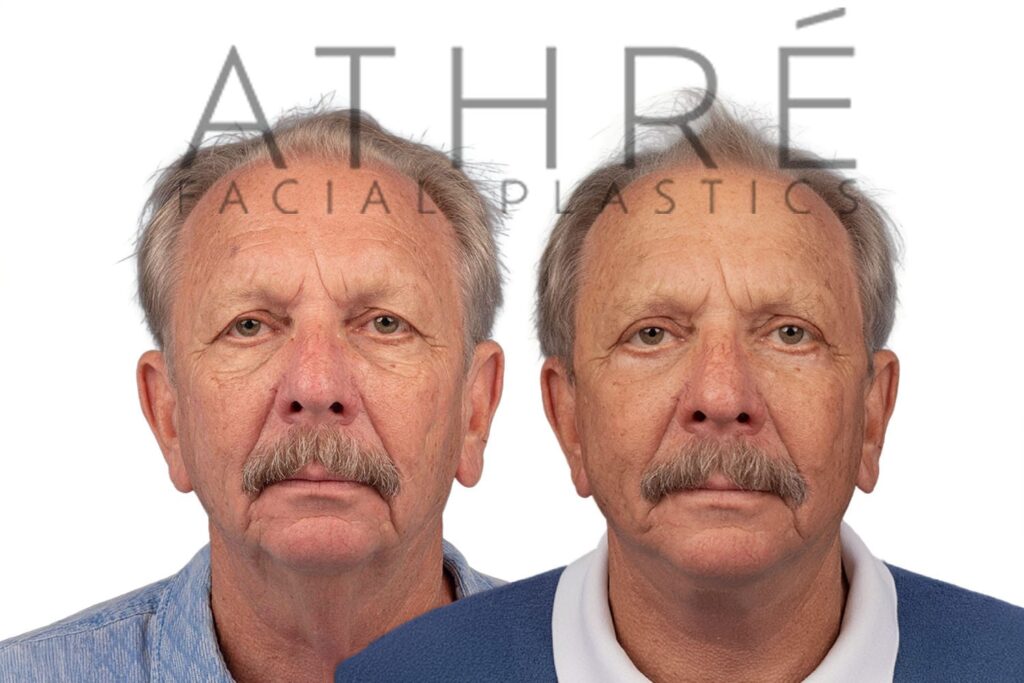
We have an example of this in our facelift before and after gallery: a 72-year-old male patient whose rejuvenation included a 4D Facelift™, deep neck lift, upper and lower blepharoplasty, facial fat transfer and nanofat treatment. This is a combined result, not the effect of a facelift alone. It illustrates why I evaluate the different areas of the face together rather than focusing on one isolated feature.
REAL MALE PATIENT
Facial Rejuvenation at Age 72
This patient underwent a combination of procedures including deep plane facelift, deep neck lift, eyelid surgery and facial fat transfer. The result demonstrates how several areas of facial aging can be addressed while preserving natural facial characteristics.
NASAL SURGERY FOR MEN
Why Men Choose Rhinoplasty
Rhinoplasty is another procedure men consider for a variety of reasons. Some have disliked a prominent dorsal hump for years. Others have a crooked nose from an old sports injury or have difficulty breathing because of a deviated septum or other structural problem.
When I evaluate a male rhinoplasty patient, I pay close attention to the relationship between the nose, forehead, chin and jawline. A nasal bridge that appears relatively strong may fit the rest of the face very well. The goal is not automatically to make the bridge smaller or give every patient a delicate, upward-rotated nasal tip.
For some men, creating a straighter nasal profile is appropriate. Others need better tip support, correction of asymmetry or changes to the nasal airway. The surgical technique should be selected to address the actual anatomical problem while maintaining the characteristics the patient wants to preserve.
I also want patients to understand that facial proportions matter. A man who feels his nose is too prominent may also have a relatively recessed chin. In that situation, I evaluate the entire facial profile rather than assuming that reducing the nose alone will achieve the balance he wants. I discuss this approach further in my article about facial profile balance.
And, just as with my female patients, I consider nasal function throughout the planning process. Improving appearance should never come at the expense of creating an unstable nasal structure or a new breathing problem.
THE BROW AND UPPER FACE
Why Brow Position Matters in Male Facial Surgery
One of the areas where male and female aesthetic planning can differ significantly is the brow. Men often have eyebrows that sit lower and appear relatively straight. As the forehead and brow age, the eyebrows can descend farther, contributing to heaviness over the eyes.
But I do not want to assume that every man with heavy upper eyelids needs a brow lift. Sometimes the problem is primarily excess eyelid skin, and removing that skin conservatively may accomplish the patient’s goal. Other times, brow descent is contributing enough to the problem that the brow itself needs to be evaluated.
A brow lift changes the position of the eyebrows, which can have a substantial effect on expression. Elevating the brow too much may create an appearance that is not consistent with the patient’s natural features. That is why I examine the relationship between the forehead, brows and upper eyelids before deciding whether to recommend eyelid surgery, brow surgery or a combination.
This is another example of why the operation should be individualized. Two men can come to me with the same complaint that their eyes look tired, but the underlying anatomy may require completely different solutions.
BEYOND SURGERY
Do Men Always Need Surgery to Look More Refreshed?
No. Not every concern requires an operation, and I think it is important to distinguish changes that can be improved nonsurgically from problems that require structural correction.
For example, a man who is beginning to notice forehead lines or crow’s feet may benefit from conservative neuromodulator treatment. I would generally approach those injections with the goal of softening the most noticeable lines while preserving appropriate facial movement and expression. Completely eliminating every line is not necessarily the best result.
Other patients are more concerned about changes in skin quality, sun damage or uneven texture. In selected cases, chemical peels, laser resurfacing or a thoughtful skin care regimen may be reasonable options.
But there are limitations. Injectables cannot reliably correct significant jowling or reposition descended tissues in the same way a facelift can. A skin treatment will not remove substantial excess upper eyelid skin or correct a structurally weak nasal tip.
I want to explain those differences during the consultation so that a patient understands what each treatment can and cannot accomplish. The best option is not always the most extensive procedure, but it should be appropriate for the concern we are trying to address.
PLANNING FOR RECOVERY
Is Recovery Different for Men?
There can be differences, but I would not assume that every male patient heals more slowly or experiences more complications than every female patient. Recovery depends on the procedure, the patient’s health, tissue characteristics, medication use and the extent of surgery.
Male tissues can present additional technical challenges during an operation. In my conversation with Chris, I discuss how thicker tissues and bleeding affected the experience of performing his eyelid surgery. But that observation does not establish a universal recovery timeline for all men. I still evaluate each patient individually.
One of the issues that deserves discussion before surgery is the amount of visible downtime the patient can accommodate. Some men work from home and can manage recovery privately. Others have jobs that require frequent meetings, public appearances or physical activity, and those responsibilities may influence scheduling.
I want patients to understand the difference between returning to daily activities and being completely healed. Early swelling and bruising may improve over the first several weeks, but the deeper tissues continue recovering, and results can evolve for months depending on the operation.
Following postoperative instructions, attending follow-up appointments, protecting the surgical area and allowing adequate time for healing remain essential. I discuss the larger recovery process in our postoperative healing program, but each patient’s specific instructions take priority.
CHOOSING THE RIGHT SURGEON
What Should Men Look for in a Facial Plastic Surgeon?
I would encourage any man considering facial plastic surgery to look beyond whether a surgeon offers a particular procedure. Ask about experience with male facial anatomy and look for genuine before and after results involving men with concerns similar to yours.
For a male facelift, pay attention to the sideburns, hairline, beard distribution and natural appearance of the jawline. For eyelid surgery, look at whether the eyes appear refreshed without becoming unnaturally rounded, hollow or excessively elevated. With rhinoplasty, consider whether the nose still fits the patient’s overall facial structure rather than simply looking smaller.
The consultation should include a clear explanation of what is causing the concern, what the surgeon proposes to change and what features should be preserved. I also think it is important to discuss limitations, risks, postoperative care and the possibility that surgery may not be the right answer for every patient.
Men sometimes approach these conversations wanting a straightforward solution. I understand that. But facial surgery is not something I want to reduce to a quick transaction. I would rather spend the time explaining the anatomy and treatment plan than have someone undergo an operation without understanding why it was recommended.
Facial Plastic Surgery Is About the Individual, Not the Gender
Men are becoming more comfortable exploring facial rejuvenation, but I do not think we should treat male plastic surgery as a completely separate concept. The fundamental principles are the same for every patient: understand the anatomy, identify a realistic goal, choose an appropriate operation and preserve the features that make the person recognizable.
The details of the surgical plan can be different. A male patient’s eyebrow position, beard distribution, nasal proportions or jawline may require a different approach from another patient’s. Those differences matter, but they should never turn into a rigid formula for what a man is supposed to look like.
Some men want a significant change to their appearance. Others simply want to look less tired or restore features that have changed with age. My job is to listen to those goals and determine whether I can address them safely and naturally.
I am not trying to make men look like someone else or fit a particular idea of masculinity. I want the result to look natural on the face of the patient sitting in front of me.
If you are considering facial surgery in Houston, you can schedule a consultation to discuss your concerns, examine your anatomy and learn which treatment options may be appropriate.
FREQUENTLY ASKED
Questions About Plastic Surgery for Men
These are some of the questions men ask about surgical options, natural-looking results, recovery and choosing an appropriate procedure.
What are the most popular facial plastic surgery procedures for men?
Eyelid surgery, rhinoplasty and facelifts are among the most commonly performed facial plastic surgery procedures for men. The American Academy of Facial Plastic and Reconstructive Surgery’s annual trends survey identifies these as leading surgical procedures among male patients. Men also consider neck lifts, brow surgery and nonsurgical treatments depending on their concerns.
Why do men choose facial plastic surgery?
Motivations vary and can include improving a long-standing concern, addressing facial aging, restoring confidence or feeling more comfortable with one’s appearance. A systematic review of motivations for facial cosmetic procedures found that personal, social and behavioral factors contribute to treatment decisions. A separate study of patient motivations found that men reported work-related considerations more frequently than women, although individual motivations differ.
Is male eyelid surgery different from female eyelid surgery?
The underlying surgical principles are similar, but average differences in eyebrow position, eyelid anatomy and aesthetic goals can influence planning. A 2024 review of male brow and eyelid rejuvenation discusses these anatomical considerations. Another review focused on male blepharoplasty emphasizes conservative tissue removal and preservation of natural eyelid fullness to avoid unintended changes in facial appearance.
Can a man have a facelift without looking overly tight or unnatural?
Yes. Appropriate surgical planning can improve facial and neck contours while preserving natural proportions. The hairline and beard-bearing skin need particular attention. A 2026 article on preserving sideburn position during male facelift surgery describes techniques intended to avoid unnatural hair displacement and visible signs of surgery. The result also depends on the patient’s anatomy, the operation performed and healing.
Does male rhinoplasty require a different technique?
Not necessarily a completely different technique, but surgical goals and anatomical details should be individualized. A 2024 review of contemporary male rhinoplasty discusses considerations specific to male patients, including anatomy, treatment expectations and the consultation process. A straighter bridge, appropriate tip rotation and adequate structural support may be important depending on the patient’s facial features and desired result.
Do men recover more slowly from facial plastic surgery?
There is no universal recovery timeline based on gender alone. Differences in skin thickness, facial hair, tissue characteristics and the procedures performed can affect surgical planning, but overall health and the complexity of surgery are also important. A review of aesthetic facial surgery in men discusses the need to adapt treatment and perioperative planning for male patients. Recovery instructions should always be individualized.
What concerns keep some men from pursuing cosmetic procedures?
Recovery time, potential complications, cost and concern that other people will notice the surgery can all influence the decision. A study of preferences and barriers among male aesthetic patients identified these concerns among respondents. A detailed consultation can help patients understand realistic outcomes, potential risks and what recovery may involve before deciding whether to proceed.