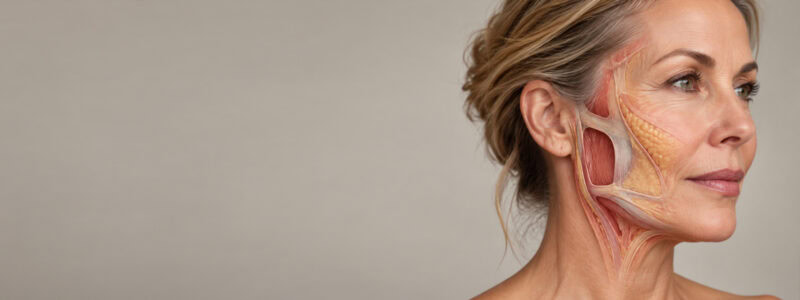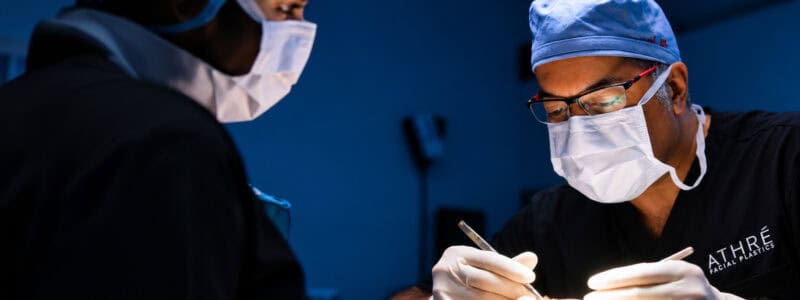
Facial aging is not only about skin becoming loose or tissues beginning to descend. We also lose volume. Facial fat transfer gives me a way to restore some of that volume using the patient’s own tissue.
But fat transfer is not simply a matter of filling every hollow area or making the face fuller. The important questions are where volume has actually been lost, what is causing the change you see and whether restoring volume is the right solution.
Sometimes facial fat transfer works very well as a standalone procedure. I also use it frequently as part of facial rejuvenation surgery because lifting tissue and restoring volume solve two different problems.
Fat can restore volume. It cannot lift tissue that has significantly descended. Knowing the difference is one of the most important parts of planning facial rejuvenation.
What Is Facial Fat Transfer?
Facial fat transfer, also called autologous fat grafting, takes fat from one area of your own body, prepares it and places it into selected areas of the face.
I commonly harvest fat from areas such as the abdomen, flanks or inner thighs. The material initially collected contains more than just usable fat, so it has to be processed before I use it in the face.
This is different from simply performing body liposuction and injecting some of that fat into the face. Facial fat grafting requires deliberate harvesting, preparation and placement.
Not All Fat Transfer Is the Same
One of the major changes in facial fat grafting has been the ability to work with smaller amounts of fat and different particle sizes rather than treating all harvested fat the same way.
I use different preparations depending on where I am working and what I want the fat to do. Larger fractions can be useful when I need deeper structural volume. Smaller fractions allow me to work closer to the skin. Nanofat is processed much more finely and is used differently from structural fat grafting.
This is why I do not think of facial fat transfer as one injection technique. It is a layered procedure. The preparation, depth and amount depend on the anatomy I am treating.
The goal is not to put fat everywhere. It is to put the right preparation in the right tissue plane for the problem I am trying to correct.
INSIGHTS FROM DR. ATHRÉ
The Evolution of Facial Fat Transfer
In this video I explain how facial fat transfer has evolved, how I prepare different fat fractions for different tissue depths, how facial volume changes with aging and why I frequently combine fat transfer with other facial rejuvenation procedures.
Volume Loss Is Only Part of Facial Aging
When people think about facial aging, they often focus on sagging. That is certainly part of it, but the face also changes in volume and shape over time. The cheeks can flatten. The temples and areas around the eyes can become more hollow. Changes in the deeper structures of the face can alter the support of the overlying soft tissues.
If a patient has primarily lost volume and the tissues are still in a good position, fat transfer may be enough to create the improvement we want.
If the tissues have significantly descended, adding more volume does not put those tissues back where they belong. That patient may need a facelift or another lifting procedure, sometimes combined with fat transfer.
Volume loss and tissue descent are different problems. Sometimes we treat one. Sometimes we need to treat both.
How Fat Transfer Compares With Facial Fillers
I used facial fillers much more frequently earlier in my career. Today, when I am treating broader facial volume loss, particularly in surgical facial rejuvenation patients, I often prefer fat.
That does not mean fillers are bad or that every patient should have fat transfer. They are different tools.
Filler can make sense when I want a small amount of targeted volume without surgery. It can also provide projection in ways that fat does not. Fat becomes particularly useful when I want to restore volume more broadly and have the ability to layer the patient’s own tissue across multiple areas of the face.
There is another fundamental difference. Filler is a manufactured injectable material. Fat is autologous tissue, meaning it comes from your own body.
Why I Often Combine Fat Transfer With a Facelift
A facelift and fat transfer are not interchangeable procedures. My 4D Facelift™ is designed to reposition tissues that have descended. Fat transfer gives me a separate way to address volume that has been lost.
Think about a cheek that has both flattened and dropped. Simply making it fuller does not necessarily restore its position. Lifting it without considering lost volume may address only part of what has changed.
That is why fat transfer appears so frequently in my facial rejuvenation patients. I can address position with surgery and volume with fat rather than asking either procedure to accomplish something it was not designed to do.
BEFORE & AFTER
Facial Fat Transfer Results
Many of these patients had fat transfer as part of a larger facial rejuvenation procedure. The other procedures matter, so I do not attribute every visible change to fat alone.


What Happens to the Fat Over Time?
Not every bit of transferred fat survives. That is one reason I would not promise a patient a fixed percentage of permanent fat survival.
Published research shows considerable variation in facial fat retention between patients, techniques and treatment areas. Some of the transferred volume is lost as the tissues heal and the remaining fat establishes a blood supply.
The fat that successfully survives can contribute to lasting volume. But your face also continues to age, and changes in body weight can affect living fat tissue.
This is why I think it is more accurate to describe fat transfer as long lasting tissue restoration rather than promising that every transferred fat cell will remain forever.
The goal is not a mathematical percentage of fat survival. The goal is a durable, natural correction that remains balanced with the rest of the face.
Who Is a Good Candidate for Facial Fat Transfer?
A patient with facial volume loss but relatively good tissue position can sometimes be an excellent candidate for fat transfer alone. I commonly look at areas such as the cheeks, midface, temples and the region around the eyes when evaluating volume.
A younger patient with localized hollowing may need very little. A patient with more advanced facial aging may need fat transfer combined with a facelift, eyelid surgery or another procedure.
This is why I do not start the consultation by asking how many syringes or how many cubic centimeters we should put into the face. I start by determining what has actually changed.
INSIGHTS FROM DR. ATHRÉ
When Volume Loss Is the Main Concern
At five weeks after facial fat transfer and lower eyelid surgery, this patient discusses the changes she is seeing and why restoring facial volume was her priority.
FREQUENTLY ASKED
Common Questions About Facial Fat Transfer
Fat transfer sounds simple until you start asking how the fat is harvested, how much survives and when it should be used instead of another treatment. These are some of the questions I hear most often.
Where does the fat for facial fat transfer come from?
I commonly harvest from the abdomen, flanks or inner thighs. I only need a relatively small amount compared with body liposuction. The harvested material is then processed before the usable fat is prepared for placement in the face.
Is facial fat transfer permanent?
A portion of successfully transferred fat can remain long term, but I would not tell a patient that every transferred fat cell survives permanently. A systematic review and meta analysis of facial fat grafting found substantial variation in retention between patients and techniques. Your face also continues to age after treatment.
How long does it take for facial fat transfer to settle?
Early fullness includes swelling, so the first few weeks should not be treated as the final result. A prospective three dimensional study of facial fat grafting demonstrated changing facial volume during the first year after treatment, which is why I want patients to give the tissues time to settle before judging the final correction.
Is fat transfer better than filler?
Not automatically. They solve different problems. I may prefer filler for a small, precise nonsurgical correction. Fat gives me the ability to restore broader areas of facial volume with the patient’s own tissue, which is particularly useful when I am already performing facial rejuvenation surgery.
Can fat transfer replace a facelift?
Not when the primary problem is significant tissue descent. Fat restores volume. A facelift repositions tissues. A patient with mild volume loss and good tissue position may do very well with fat alone, while a patient with more significant descent may need a lifting procedure.
Why combine fat transfer with a facelift?
The procedures address different components of facial aging. The facelift can reposition descended tissue while fat can restore selected areas of lost volume. Three dimensional research on facelift with simultaneous fat grafting has documented measurable midfacial volume changes extending beyond the early postoperative period.
Is facial fat transfer safe?
Facial fat grafting is a surgical procedure and it has risks. A systematic review of facial fat grafting complications reported issues including asymmetry, contour irregularities, prolonged swelling, fat necrosis and infection. Serious vascular complications are uncommon but can be severe, which is why detailed knowledge of facial anatomy and careful technique matter.
Will my face look overfilled after fat transfer?
That is specifically what I am trying to avoid. My goal is not to make the face uniformly fuller. I look for where volume has been lost and whether restoring it improves the relationship between the surrounding features. Early swelling can temporarily make the face look fuller, so the immediate postoperative appearance is not the final result.
Can facial fat transfer be repeated later?
Yes. Not every patient needs another procedure, but additional fat grafting can be considered if more correction is appropriate later. Retention varies and facial aging continues. A five year follow up study of facial fat grafting also found that long term facial volume can be influenced by changes in body weight.