
A liquid rhinoplasty sounds appealing. Instead of having surgery, you receive a small amount of injectable filler to change the appearance of your nose. There’s no operating room, recovery is generally shorter, and you can see an immediate change. So why don’t I recommend it for most of my patients?
I’ve performed rhinoplasty for many years, and I understand why people are attracted to a nonsurgical alternative. Someone with a small hump on the bridge of their nose may not want an operation simply to achieve a straighter profile. If that change can be accomplished with an injection, it seems like an easier solution. The problem is that liquid rhinoplasty and surgical rhinoplasty accomplish very different things, and the risks associated with injecting filler into the nose are more significant than many patients realize.
In my practice, I generally recommend surgical rhinoplasty when someone wants to change the shape of their nose. There are limited situations where filler can be useful, particularly for a minor irregularity following previous surgery, but I approach those situations very cautiously. I think patients should understand what filler actually does, what it cannot accomplish, and why the vascular anatomy of the nose makes these injections potentially dangerous.
UNDERSTANDING LIQUID RHINOPLASTY
What Is a Liquid Rhinoplasty?
A liquid rhinoplasty, sometimes called a nonsurgical nose job, involves injecting dermal filler into selected areas of the nose to change its visible contour. The products most commonly discussed for this purpose are hyaluronic acid fillers, such as Restylane and Juvéderm. These products add volume beneath the skin, allowing the physician to camouflage certain depressions or irregularities without changing the underlying bone and cartilage.
Let’s say you have a small dorsal hump. One option is to inject filler into the depression immediately above that hump, making the bridge look straighter. The hump hasn’t actually disappeared, but the additional volume can make it less noticeable. Filler may also be used to camouflage selected asymmetries or minor contour irregularities. What it cannot do is remove a hump, make a large nose smaller, shorten the nasal framework, or correct problems with the internal airway.
I want to show you an example from one of my original rhinoplasty discussions. These three images illustrate the difference between camouflaging a nasal concern with filler and actually changing the nasal anatomy through surgery.
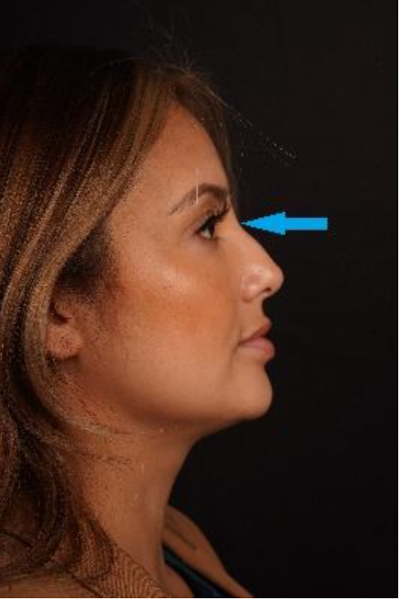
IMAGE 01 — ORIGINAL NOSE
Camouflaging a Dorsal Hump
This patient has a relatively small hump on the bridge of her nose. The blue arrow identifies the area where filler could theoretically be added to create a smoother profile.
But notice what we’re doing. We’re making one part of the nose larger to conceal another. That may improve the profile, but it doesn’t correct the underlying nasal anatomy.

IMAGE 02 — FILLER SIMULATION
What Liquid Rhinoplasty Might Achieve
This computer-generated image illustrates how adding filler could make the bridge appear straighter. The hump is still there, but the added volume changes the visible contour.
For someone wanting a small improvement, that may seem appealing. However, this is only a simulation, not an actual filler result, and it cannot demonstrate the structural changes possible with surgery.

IMAGE 03 — SURGICAL RESULT
Reshaping the Nasal Framework
This patient underwent surgical rhinoplasty. Rather than adding filler to disguise the hump, I reshaped the nasal bridge and refined the tip, creating a softer, more balanced profile through structural changes.
Now look at the third image. This patient underwent surgical rhinoplasty, allowing me to address the nasal bridge and tip together. Instead of adding filler to hide the hump, I was able to change the underlying anatomy to create a softer, more balanced nasal profile. That’s the fundamental limitation of liquid rhinoplasty: it can disguise certain features, but it cannot accomplish the range of structural changes available through surgery.
Why Do Patients Choose Liquid Rhinoplasty?
There are understandable reasons patients consider it. The initial cost is usually lower than surgery, the appointment is shorter, and most people can return to ordinary activities relatively quickly. There’s no surgical recovery involving nasal dressings or the longer process of waiting for swelling to resolve. For someone who has been thinking about changing their nose but doesn’t feel ready for an operation, those advantages can be persuasive.
However, the cost comparison isn’t as simple as one filler treatment versus one surgery. Hyaluronic acid fillers are generally considered temporary, although the visible correction and the persistence of the material can vary considerably. Some patients need repeat treatments to maintain the appearance, and residual filler may remain in the tissues longer than expected. With surgery, the initial investment is greater, but the structural changes are intended to provide a long-term result, even though the nose continues to age and healing is never entirely predictable.
Recovery is another factor I discuss with patients. Liquid rhinoplasty generally involves less downtime, but surgical rhinoplasty doesn’t always require the prolonged interruption people imagine. With some of the contemporary dorsal preservation techniques I use, many patients can resume nonstrenuous work and ordinary social activities within approximately a week. That doesn’t mean they’re completely healed; swelling can continue improving for months. But I want patients to compare the actual recovery involved with each approach rather than assuming that surgery necessarily means several weeks away from normal life.
WHY I AM CAUTIOUS
Why I Usually Recommend Against Liquid Rhinoplasty
My primary concern is the blood supply of the nose. It’s a highly vascular structure, and some of the arteries supplying the nose communicate with vessels that also supply the eye. If filler accidentally enters an artery, it can obstruct blood flow to critical tissues. These complications are uncommon, but they can be devastating, which is why I have always been reluctant to treat nasal filler as a routine cosmetic injection.
The most serious complication is blindness. Filler can enter the arterial circulation and, under certain circumstances, reach the vessels supplying the retina. If blood flow is blocked, the resulting loss of vision may be permanent. There have been documented cases of blindness following nonsurgical rhinoplasty, and unfortunately there is no treatment that reliably restores vision once a severe injury has occurred. Stroke has also been reported following facial filler injections.
Another concern is skin necrosis. If filler obstructs a vessel supplying the nasal skin, the affected tissue can lose its blood supply, resulting in injury, tissue loss and potentially permanent scarring. The nose has very little excess skin, so a significant injury can create a deformity that is much more difficult to manage than the original cosmetic concern. Patients should understand that unusual pain, whitening or dark discoloration of the skin, or any visual symptoms following filler injection require immediate medical attention.
There is also the question of what happens to the nasal tissues over time. My approach to rhinoplasty has evolved toward preserving healthy anatomy and limiting unnecessary foreign material. I have seen how previous injections, implants and associated scarring can complicate an operation, particularly when I’m working with delicate tissue planes. Not every patient who receives filler develops scar tissue or surgical difficulties, but introducing material into the nose can create additional considerations if the patient eventually decides to have a rhinoplasty.
The clinical photographs below illustrate tissue injury following nasal filler injection. They are graphic, but I think they help explain why I take these risks seriously.
View clinical photographs of nasal tissue damage

When I consider these risks alongside the limitations of what filler can accomplish, I generally believe surgical rhinoplasty is the more appropriate option for patients seeking meaningful changes to nasal shape. Surgery certainly carries risks of its own, and I would never suggest otherwise. But it allows me to work directly with the underlying anatomy rather than repeatedly adding material to camouflage a structural concern.
INSIGHTS FROM DR. ATHRÉ
Liquid Rhinoplasty vs. Surgical Rhinoplasty
I discuss liquid rhinoplasty with my mentor, Dr. William Silver. We explain why filler cannot replace structural rhinoplasty and the limited situations where a small injection may still be appropriate.
Are There Situations Where I Would Consider Nasal Filler?
Yes, and I explain this in my conversation with Dr. Silver. Imagine a patient who has undergone a very complicated revision rhinoplasty and is left with a tiny irregularity that is barely noticeable but still bothers them. I may be able to camouflage that irregularity with a very small amount of filler. In that particular situation, opening the nose again and performing another operation could introduce more risk, scarring and recovery than the problem justifies.
That’s a very different conversation from someone coming into my office wanting to replace an entire rhinoplasty with filler. In the first situation, we’re considering whether a minor adjustment might be worthwhile after an extensive operation. In the second, we’re trying to create a structural change without actually changing the structure. Even in the limited situations where I consider filler, I need to evaluate the patient’s previous surgery, vascular anatomy, tissue characteristics and expectations before recommending anything. Sometimes the best decision is to leave a very small irregularity alone.
Can Liquid Rhinoplasty Be Performed Safely?
Many patients receive nasal filler without serious complications, but no injection technique can eliminate the risk. If someone is considering this procedure, I believe they should see a physician who has extensive knowledge of nasal anatomy and experience managing vascular complications. The physician should also explain the product being used, the limitations of the expected result and the emergency plan if a complication occurs.
Hyaluronic acid fillers have the advantage of being treatable with hyaluronidase, an enzyme that can break down the filler. I would want that medication immediately available when performing hyaluronic acid injections, but it is important to understand that hyaluronidase does not guarantee reversal of tissue injury or restoration of vision. Likewise, using a blunt cannula or performing aspiration before injection does not guarantee that a blood vessel will be avoided. These are considerations in risk reduction, not assurances that a serious complication cannot occur.
For this reason, I am especially cautious about permanent or difficult-to-reverse filler products in the nose. Even when a patient is being treated by a highly experienced physician, there remains a possibility of an unpredictable vascular event. The decision should be based on whether the expected improvement is meaningful enough to justify accepting that risk.
What If You’ve Already Had a Liquid Rhinoplasty?
Having previously received filler doesn’t automatically prevent someone from undergoing surgical rhinoplasty. However, it is important that I know what was injected, when it was injected and whether the patient has undergone repeated treatments. Depending on the product and how the tissues have responded, there may be residual filler, inflammation or scar tissue that affects my surgical planning. These issues are particularly important when evaluating someone for revision rhinoplasty or a more complex nasal reconstruction.
In some cases, I may recommend dissolving residual hyaluronic acid filler before finalizing the surgical plan. In others, the material may not interfere significantly with the operation. I make that decision after examining the patient rather than applying one rule to everyone. I also encourage patients to be completely open about their injection history, because understanding what has already been done to the nose helps me develop a safer and more realistic plan.
Why I Prefer Surgical Rhinoplasty
When a patient comes to see me because they dislike the shape of their nose, I want to understand exactly what is bothering them. It may be a dorsal hump, a wide tip, a nose that projects too far from the face, or changes that have occurred with age. I also evaluate breathing and the structural support of the nose, because appearance and function are closely connected. Once I understand the anatomy and the patient’s goals, I can determine whether surgery would offer an appropriate solution.
With surgical rhinoplasty, I can reshape the nasal framework, refine the tip, modify projection and address certain problems affecting the airway. These are changes that filler cannot accomplish. My goal is not simply to make a nose smaller or create a particular shape. I want to achieve a natural result that fits the patient’s facial proportions while preserving or improving nasal function when appropriate.
Liquid rhinoplasty can make sense in selected circumstances, and I don’t dismiss every possible use. But for most patients who want a meaningful, lasting change in the shape of their nose, I believe surgery deserves serious consideration. I’d rather address the underlying anatomy than create the temporary appearance of a correction by adding more material.
I don’t believe the best treatment is always the one that seems easiest at first. It’s the one that addresses the patient’s actual concern while offering a reasonable balance of benefit, longevity and risk.
You can learn more about my approach on our rhinoplasty procedure page, review actual results in the rhinoplasty before and after gallery, or schedule a consultation to discuss which options may be appropriate for your nose.
FREQUENTLY ASKED
Questions About Liquid Rhinoplasty
Patients frequently ask whether nasal filler is safer, less expensive or a reasonable alternative to surgery. Here are some of the issues I discuss during a consultation.
Is liquid rhinoplasty FDA-approved?
No dermal filler is FDA-approved specifically for injection into the nose, and the FDA recommends against this use. Some fillers are approved for other areas of the face, but that approval does not extend to every anatomical location. The FDA’s dermal filler safety guidance specifically identifies the nose among the locations where injection is not recommended, citing the possibility of serious complications involving blood vessels.
Can a liquid rhinoplasty cause blindness?
Yes. Although uncommon, blindness is a documented complication of nasal filler injection. Filler can enter the arterial circulation and obstruct vessels supplying the retina, sometimes causing permanent vision loss. A published case report of blindness following nonsurgical rhinoplasty illustrates the severity of this complication. The possibility of visual injury is one of the main reasons I generally recommend against elective nasal filler treatment.
How common are serious complications from liquid rhinoplasty?
Most reported complications are minor, such as bruising or swelling, but vascular occlusion, skin necrosis and vision loss have been documented. A systematic review and meta-analysis involving 8,604 patients reported cases of these serious complications. Another updated systematic review found that serious vascular complications remain a concern despite generally high patient satisfaction. Reported rates depend on the available studies and may not capture every event.
Does using a cannula make nasal filler injections safe?
No technique completely eliminates the possibility of vascular injury. Blunt cannulas, careful anatomical planning and other precautions may reduce certain risks, but vascular complications can still occur. A review of preventing and managing nonsurgical rhinoplasty complications emphasizes that serious events remain possible even when appropriate risk-reduction measures are used. Patients should be cautious about any claim that a particular injection method guarantees safety.
Can hyaluronidase reverse a liquid rhinoplasty complication?
Hyaluronidase can break down hyaluronic acid filler and is an important part of managing certain filler complications. However, it cannot guarantee recovery after an arterial injury, particularly when vision is affected. A review of vision loss following nonsurgical rhinoplasty describes the limitations of available treatments and the potential for permanent visual impairment. Any suspected vascular complication requires immediate medical evaluation.
Is liquid rhinoplasty a substitute for surgical rhinoplasty?
No. Filler can temporarily camouflage selected nasal contours, but it cannot remove bone or cartilage, make the nose structurally smaller, or correct nasal airway obstruction. A 2024 systematic review of nonsurgical rhinoplasty describes its use for selected cosmetic improvements while documenting its limitations and complications. Surgical rhinoplasty offers a wider range of structural changes, although it requires an operation and carries its own risks.


