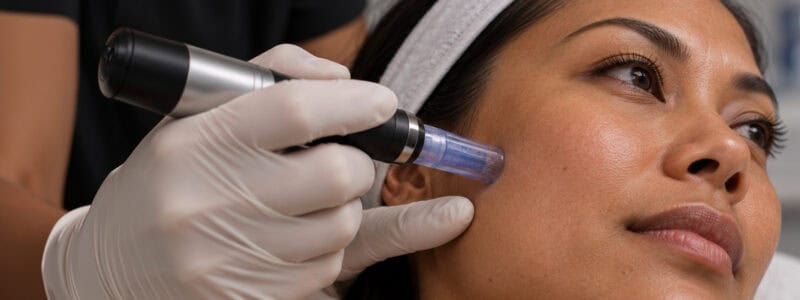
When patients ask me about treatments for aging skin, they often want something that will make the face look fresher without requiring much recovery. Microdermabrasion is one of the treatments that comes up. It is relatively gentle, but the real question is whether it can improve the specific changes they are seeing.
Fine lines, sun damage, enlarged pores, dullness and deeper wrinkles are not all the same problem. Some involve the skin’s outer surface. Others develop because of changes in collagen, volume and the supporting structures underneath it.
Microdermabrasion can improve certain surface concerns. What I do not want is for someone to mistake a smoother complexion for a treatment that reverses facial aging.
If you are considering microdermabrasion for aging skin, the question is not just whether it works. It is whether it works for what you want to change.
Which Signs of Aging Can Microdermabrasion Actually Improve?
When I evaluate skin aging, I separate changes in surface quality from changes that extend deeper into the skin or underlying face. Microdermabrasion is a superficial exfoliating treatment. That makes it more useful for some concerns than others.
The four examples below show why I would not give the same recommendation for every sign of aging.
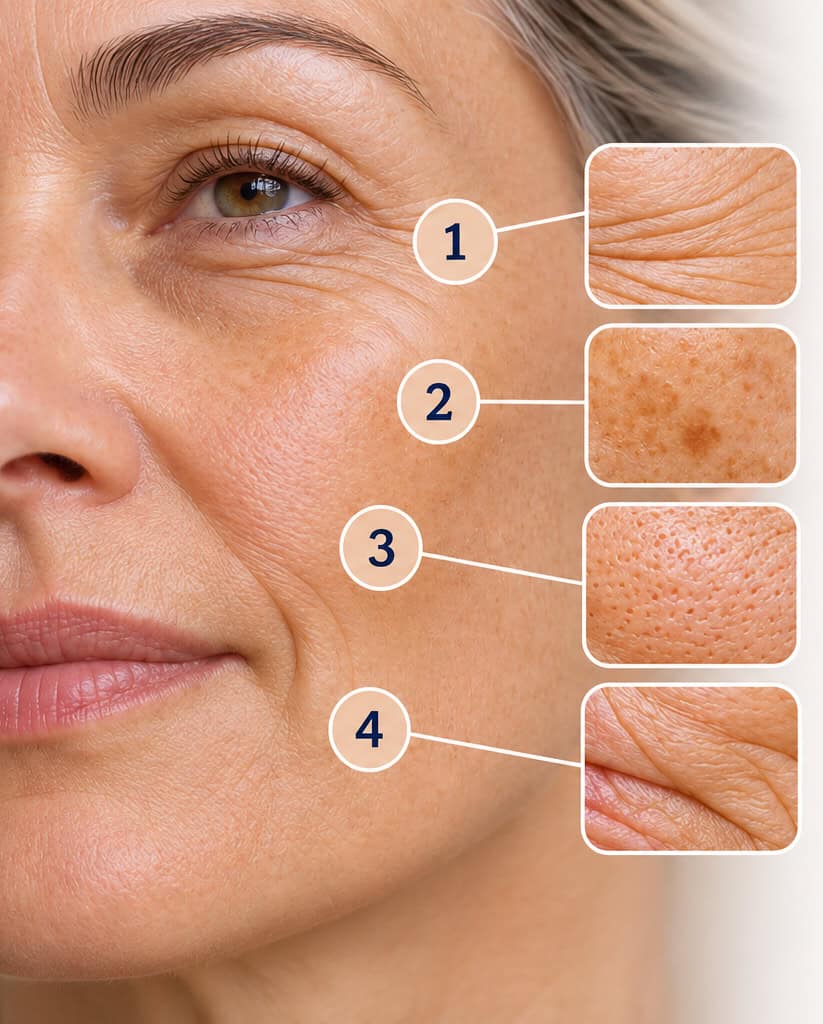
01 Fine Lines
Some very fine surface lines may look softer as the skin becomes smoother. Established wrinkles usually change much less.
02 Uneven Pigmentation
Superficial discoloration may improve, but deeper sun damage and persistent age spots often need a more targeted treatment.
03 Visible Pores
Exfoliation can make pores less noticeable by refining the surface. It does not permanently shrink the openings.
04 Deeper Wrinkles
Deep creases come from changes that extend below the surface. Microdermabrasion is not designed to correct them.
There is another benefit that does not always show clearly in a close-up photograph: skin can feel smoother and look less dull after superficial exfoliation. For someone whose main concern is roughness rather than deeper aging, that may be the improvement they were looking for.
Can Microdermabrasion Soften Fine Lines on Mature Skin?
It can help some fine surface lines look less noticeable, but I would be careful about promising wrinkle reduction.
Think about the difference between a faint line that is most noticeable when the skin looks dry or rough and a crease that is present even when the face is relaxed. Smoothing the outer surface may improve the first. It is not going to remove the structural changes creating the second.
I also look at where the lines are. Fine texture around the cheeks is different from deeper lines around the mouth or pronounced crow’s feet. Those areas can require different treatments because the causes are different.
Smoother skin can make fine lines less noticeable. It does not mean the wrinkles underneath have been erased.
SUN DAMAGE AND SKIN TONE
What About Age Spots and Uneven Pigmentation?
Uneven pigmentation is one of the changes patients often notice as they get older. Years of sun exposure can leave the skin looking blotchy, with areas that are darker than the surrounding complexion.
Microdermabrasion can sometimes improve superficial pigment irregularities because it removes part of the outermost skin layer. But I would not treat every dark spot as the same problem. A true sun spot, melasma and post-inflammatory pigmentation have different causes and may respond differently to exfoliation.
If the discoloration is deeper or more established, a carefully selected chemical peel or a pigment-focused treatment may make more sense. I also want any changing, irregular or otherwise concerning spot evaluated before cosmetic treatment.
Does Microdermabrasion Really Make Pores Smaller?
It may make them look smaller. That is different from permanently changing their size.
Pore visibility can be influenced by oil, surface buildup, genetics and changes in skin support over time. When the skin surface is smoother and less congested, pores may become less apparent. But microdermabrasion does not change the underlying architecture of the pore.
This is also where patients sometimes notice that makeup applies more evenly after exfoliation. A smoother surface can make a practical cosmetic difference, even when the actual anatomical change is modest.
Why Dull or Rough Skin Can Look More Refreshed
As the skin’s outer surface becomes uneven, it can scatter light differently and look less smooth. Removing superficial buildup can temporarily make the complexion appear brighter and feel softer.
For a patient primarily bothered by roughness and dullness, that can be a worthwhile benefit. I just would not confuse it with treating the deeper loss of firmness or volume that can also accompany aging.
Why Microdermabrasion Cannot Reverse Deeper Facial Aging
There is a point where exfoliating the surface simply does not reach the source of the problem.
Deeper wrinkles develop through changes in skin structure, repeated muscle movement and the tissues beneath the skin. Loose skin and jowling involve additional changes in facial support. Those are not problems that can be corrected by removing a few superficial layers of dead skin cells.
Microdermabrasion also should not be presented as a substitute for treatments intended to remodel damaged skin at greater depth. Depending on the concern, I may consider laser resurfacing, chemical peels or other approaches that more directly address the tissue involved.
I do not want to dismiss a gentle treatment because its effects are modest. I want to use it for the kind of improvement it can actually deliver.
Is One Microdermabrasion Session Enough for Aging Skin?
If someone wants their skin to feel smoother, they may notice a difference after one session. But many of the studies looking at changes in fine lines, pigmentation and photoaging have used a series of treatments rather than a single appointment.
That does not mean everyone needs to commit to a long treatment plan. It means expectations should match the problem. A person wanting mild surface exfoliation may be satisfied with occasional treatment, while someone trying to improve more established discoloration may find that microdermabrasion alone is not the most effective approach.
I also want to avoid treating the skin more frequently simply because the procedure has little downtime. Repeated exfoliation can irritate an already sensitive barrier. Treatment spacing should follow the condition of the skin and the provider’s instructions.
Does Microdermabrasion Build Collagen in Aging Skin?
You will often see microdermabrasion advertised as a collagen-building treatment. There have been studies examining changes within the skin after repeated or more intensive treatment, so there is a biological basis for discussing a healing response.
But I would not take that finding and promise the same degree of collagen remodeling from every routine facial treatment. The intensity of treatment, the number of sessions and the way improvement is measured all matter.
More importantly, evidence of some remodeling does not mean we can use microdermabrasion to correct significant skin laxity or replace deeper resurfacing.
Collagen activity is not the same thing as a meaningful lift or a major reduction in wrinkles.
So, Is Microdermabrasion Worth It for Aging Skin?
I think it can be, when the goal is realistic.
If the main concern is a rough or dull complexion, mild surface texture changes or certain superficial pigment irregularities, a relatively gentle exfoliating treatment may be reasonable. Some people also enjoy taking time for skincare. That is a valid reason to choose a treatment, but I would not present the appointment itself as a proven way to reduce stress hormones or treat a medical condition.
If the goal is to reduce deep wrinkles, correct substantial sun damage or tighten sagging skin, I would explain why microdermabrasion is unlikely to provide the result the patient has in mind.
For a broader overview of the available options, our skin resurfacing guide explains how different treatments work at different depths. If you want to understand the device, procedure and recovery of microdermabrasion itself, read Microdermabrasion: What Works, What Doesn’t.
I would rather choose a treatment that makes a small but useful difference than recommend a superficial treatment for a problem it cannot reach.
FREQUENTLY ASKED
Questions About Microdermabrasion for Aging Skin
What published research tells us about photoaging, fine lines, pigmentation, pore appearance and the limits of superficial skin treatments.
Does microdermabrasion work on aging skin?
It can improve some surface changes, although results are generally modest. A 38-patient clinical and histologic study found that improvement in the photoaging group after eight sessions was mainly mild.
Can microdermabrasion reduce wrinkles on mature skin?
Some fine wrinkles may look softer, but the findings are mixed. A six-session study reported improvement in fine wrinkles, while another clinical study found better texture and pigmentation without significant wrinkle improvement.
Can microdermabrasion improve age spots or sun damage?
It may improve certain superficial pigment changes. In a controlled study of photodamaged skin, blinded observers identified improvement in areas of excess pigmentation, but wrinkle improvement was less consistent.
Does microdermabrasion permanently shrink pores?
No evidence establishes permanent pore shrinkage. A small study of six microdermabrasion sessions reported improvement in the appearance of large pores, but that is not the same as permanently changing pore anatomy.
Does microdermabrasion stimulate collagen production?
Some studies have found tissue changes consistent with remodeling. A skin-biopsy study after a series of treatments reported new collagen and elastic fibers, but this does not establish that routine treatment produces substantial tightening.
Is one treatment enough to improve signs of aging?
Surface smoothness may change after a single treatment, but many clinical studies used a series. One study of 16 women found measurable improvements by the third session, with additional improvement after six.
How long do microdermabrasion benefits last?
They are not necessarily permanent. In a study with a 90-day no-treatment follow-up, some improvements remained but were less pronounced than immediately after the treatment series.
Does mature skin need recovery time after microdermabrasion?
Recovery is usually brief, although temporary irritation is possible. A 28-patient study of diamond microdermabrasion found that measured skin barrier function returned to baseline within about two days.
Can microdermabrasion replace deeper anti-aging treatments?
No. Its effects on photoaging are usually modest. A clinical review of microdermabrasion describes mild benefits for photoaged skin, which should not be confused with correction of deep wrinkles or significant laxity.