Patients sometimes come to me asking for a laser because they want tighter skin. Others want to improve wrinkles, sun damage or skin that simply does not look as smooth as it used to.
The first thing I want to determine is whether the problem is actually in the skin.
A CO2 laser can be an extremely useful tool for improving skin quality. It can create controlled injury at the surface and within the skin, initiating a healing response that remodels collagen. What it cannot do is reposition a descended cheek, correct a jowl or rebuild a neck contour that has changed because of deeper anatomy.
A CO2 laser does not lift the face. It changes the skin. I use it when skin quality is part of the problem I am trying to correct.
What Is CO2 Laser Resurfacing?
A CO2 laser produces light at a wavelength that is strongly absorbed by water. That is useful because water is abundant in skin.
When that energy reaches the skin, it can remove microscopic amounts of tissue and create controlled thermal injury in the surrounding tissue. The skin then has to heal.
That healing process is the point.
The objective is not simply to burn away the surface. I am creating a controlled injury at a depth and density appropriate for the problem I am treating, then allowing the skin’s wound-healing response to do the biological work that follows.
What Is the Laser Actually Changing?
Your skin is not one uniform sheet. The epidermis forms the outer surface. Beneath it is the dermis, which contains collagen, elastin and other components that contribute to the skin’s structure.
With age, ultraviolet exposure and other environmental influences, the skin changes. Fine lines become more visible. Texture becomes less uniform. Pigmentation can become irregular. The collagen framework underneath the surface also changes.
Laser resurfacing gives me a way to treat some of those changes directly.
That is very different from what I am doing during a facelift. A facelift changes the position of deeper facial tissues. A resurfacing laser treats the skin itself.
If the problem is tissue position, I need to think structurally. If the problem is skin quality, I need a tool designed to change the skin.
HOW CO2 RESURFACING WORKS
What Does “Fractional” CO2 Mean?
This is where some of the terminology becomes confusing.
CO2 describes the type of laser. Fractional describes the way that laser energy is delivered to the skin.
A fully ablative treatment treats the surface more continuously. Fractional resurfacing divides the treatment into microscopic columns, leaving areas of untreated skin between those columns.
I think of it less like sanding an entire surface evenly and more like creating a very precise pattern of treatment throughout the skin.
Those untreated areas between the microscopic treatment zones are important because they participate in the healing process.
This is also why the word “Fraxel” should not be used as though it means every fractional laser. Fraxel is a brand name. Fractional resurfacing is the broader treatment concept.
Fully Ablative vs. Fractional CO2 Resurfacing
The difference is easier to understand visually. A fully ablative treatment creates a more continuous area of resurfacing, while fractional CO2 creates microscopic treatment columns with untreated skin remaining between them.
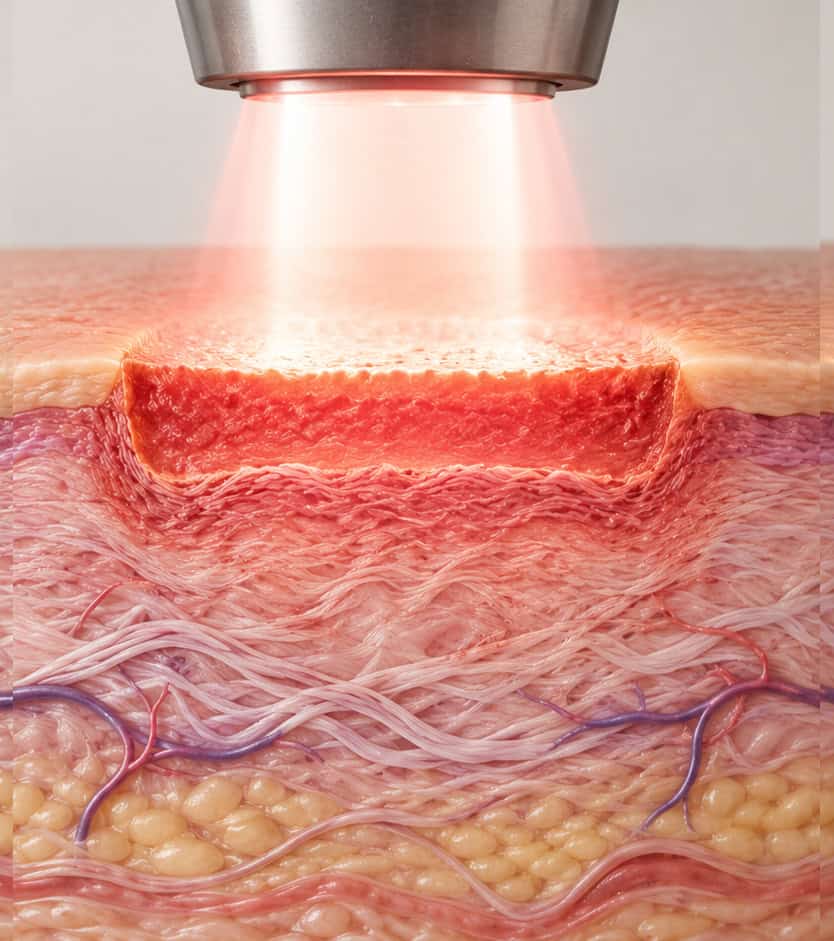
Fully Ablative CO2
The treated surface is resurfaced more continuously, creating a larger continuous wound that must heal.
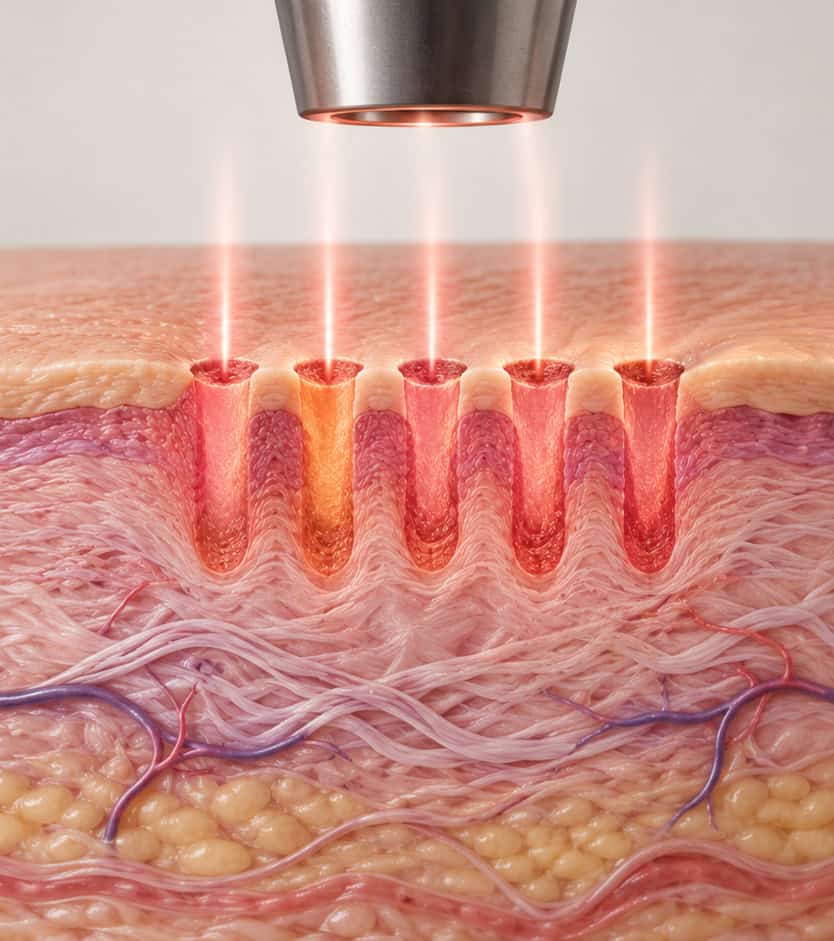
Fractional CO2
Microscopic treatment columns are separated by areas of untreated skin that participate in the healing process.
WHAT IT CAN CHANGE
What Can CO2 Laser Resurfacing Improve?
I consider CO2 resurfacing when I am trying to improve problems that live primarily in the skin rather than underneath it.
That can include fine lines and wrinkles, rough texture, photodamage, areas of uneven pigmentation and selected scars. It can be particularly useful around the mouth and eyes, where skin texture and fine lines can remain even after the deeper facial structures have been rejuvenated.
The treatment has to match the problem. A very superficial texture issue does not necessarily require the same settings or treatment depth as deeper etched lines.
That is one of the advantages of having multiple resurfacing tools available. CO2 is not the answer to every skin problem simply because it is powerful.
What CO2 Laser Resurfacing Does Not Fix
This is just as important as understanding what the laser can improve.
A CO2 laser does not reposition a descended cheek. It does not release facial retaining ligaments. It does not correct significant jowling by moving the deeper facial tissues. It does not remove deep neck fat or change the deeper muscular and glandular structures that can affect neck contour.
Laser resurfacing can make skin look smoother and improve certain wrinkles, but smoother skin over descended tissue is still descended tissue.
Resurfacing and lifting solve different problems. Sometimes a patient needs one. Sometimes the most complete result comes from treating both.
How Do I Choose Between Fractional and Fully Ablative CO2?
The tradeoff in resurfacing is usually between how aggressively I treat the skin and how much healing I am asking the patient to go through.
A fully ablative CO2 treatment removes the treated surface more continuously. That can create a substantial resurfacing effect, but it also creates a larger wound and generally requires a more involved recovery.
Fractional CO2 leaves intervening areas of skin untreated. That changes the healing pattern and can allow me to deliver meaningful resurfacing while reducing the extent of continuous surface injury.
Neither approach is automatically right for everyone.
I choose the treatment based on the skin, the depth of the problem, pigmentation risk, the area being treated and how much recovery makes sense for that patient.
SKIN TYPE & SAFETY
Can I Use CO2 Laser Resurfacing on Darker Skin?
Possibly, but this is an area where I become more conservative.
The fact that a CO2 laser primarily targets water does not mean skin color becomes irrelevant. Darker skin can respond to inflammation by producing more pigment, which means post-inflammatory hyperpigmentation becomes an important part of treatment planning.
I therefore look at skin type, baseline pigmentation, previous reactions to inflammation, sun exposure, the area I am treating and how aggressive the resurfacing needs to be.
In some patients I may modify the settings or treatment density. In others, I may decide that another resurfacing strategy gives me a better balance between improvement and pigment risk.
Why I Sometimes Combine Resurfacing With Facial Rejuvenation
This is where resurfacing fits naturally into the way I think about facial aging.
A patient can have descended facial tissues, volume loss and significant skin aging at the same time. Correcting the tissue position does not automatically correct the skin, and resurfacing the skin does not reposition the tissues underneath it.
That is one reason skin treatment can become part of my 4D Facelift™ planning.
I may use a facelift to reposition deeper facial tissues, fat transfer when volume restoration is appropriate and resurfacing when the skin itself needs treatment.
Those are separate tools solving separate parts of the same aging process.
I don’t want to ask one procedure to solve every dimension of aging. I want each part of the treatment plan to have a reason for being there.
What Skin Resurfacing Results Can Look Like
These examples come from my skin resurfacing gallery. Several of these patients underwent resurfacing as part of a larger facial rejuvenation plan, so I do not want to imply that every difference you see in the photographs was created by the laser alone.
Instead, look specifically at the skin around the eyes, cheeks and other resurfaced areas while remembering that facial shape may also have changed because of surgery, fat transfer or other treatments performed at the same time.
BEFORE & AFTER
Skin Resurfacing Results


What Is CO2 Laser Recovery Like?
Recovery depends heavily on how aggressively the skin was treated.
Redness, swelling, warmth, peeling or crusting can occur during the early healing period. A deeper or more densely treated surface generally requires more recovery than a lighter fractional treatment.
The first phase is wound healing. After that, the skin can remain pink or reactive while the deeper remodeling process continues.
This is why I do not like giving every CO2 patient one universal downtime number. The treatment itself is adjustable, so the recovery is adjustable too.
Sun protection becomes particularly important during this period because newly treated skin is vulnerable to pigment changes.
How I Decide How Aggressively to Resurface
I start with what I am actually trying to improve.
Fine lines are different from deep etched wrinkles. Sun damage is different from acne scarring. Lower eyelid skin is different from cheek skin. A patient with very fair skin may allow me to make different choices than a patient whose skin develops pigment easily after inflammation.
I also need to know how much recovery the patient is willing to accept.
The goal is not to use the highest possible setting. The goal is to create enough controlled injury to produce the improvement I want while respecting the skin’s ability to heal safely.
That is the same way I think about the rest of facial plastic surgery. More aggressive is not automatically more sophisticated.
The laser is the tool. The treatment plan is deciding where, why and how much to use it.
FREQUENTLY ASKED
CO2 Laser Resurfacing Questions
These are some of the questions I hear from patients trying to understand fractional CO2 resurfacing, recovery and whether the treatment makes sense for their skin.
What does fractional CO2 laser resurfacing actually do?
It creates microscopic zones of ablation and thermal injury that trigger wound healing and collagen remodeling. Clinical and histologic research has demonstrated new collagen formation after fractional CO2 resurfacing.
Is fractional CO2 different from traditional CO2 resurfacing?
Yes. Fractional treatment creates microscopic treatment zones separated by untreated skin rather than ablating the entire treated surface continuously. A review of fractionated CO2 skin rejuvenation describes this approach and its role in treating photoaging.
Can someone with darker skin have a CO2 laser treatment?
Selected patients can, but pigment risk requires careful treatment planning. Evidence on fractional resurfacing in darker skin types supports its use while emphasizing appropriate patient selection and technique. Darker skin is more susceptible to post-inflammatory pigment changes, so I may modify the treatment or recommend another approach.
Why is hyperpigmentation a concern after CO2 laser resurfacing?
Inflammation can stimulate excess pigment production, particularly in melanin-rich skin. A review of post-inflammatory hyperpigmentation in skin of color discusses the greater susceptibility of Fitzpatrick skin types III through VI and the importance of appropriate laser selection and parameters.
What are the common side effects of fractional CO2 resurfacing?
Redness and swelling are expected early effects. Less common complications can include infection, prolonged redness and pigment changes. A study of 490 fractional CO2 treatments documented acneiform eruptions, herpes outbreaks, infections and hyperpigmentation among reported adverse events.
Does CO2 laser resurfacing stimulate collagen?
Yes. Histologic research after fractional CO2 treatment has shown wound-healing changes and new collagen deposition. That remodeling is one reason improvement can continue after the surface has healed.
Can CO2 laser resurfacing replace a facelift?
No. CO2 resurfacing treats skin quality. A facelift repositions deeper facial tissues. They can complement each other, but they solve different anatomical problems.
How long does fractional CO2 laser recovery take?
It depends on treatment depth, density and the individual patient. Expert recommendations for fractional ablative CO2 resurfacing emphasize adjusting treatment parameters and aftercare to the patient rather than applying one recovery expectation to everyone.
How do you decide which CO2 laser settings to use?
I consider the area being treated, wrinkle or scar depth, skin type, pigmentation risk and the amount of correction we are trying to achieve. Current expert recommendations for fractional CO2 laser treatment similarly emphasize individualized settings and patient selection.