When patients talk to me about rejuvenating their lips, the conversation often starts with volume. I look at something different first: what has actually changed?
The upper lip can become longer with age. Less of the pink lip may be visible. Upper tooth show can decrease. The lips themselves can lose volume, and the corners of the mouth can change position.
Those are different problems, and they do not all have the same solution.
A lip lift is not primarily about making the lips bigger. It is about changing their position and proportions.
LIP AGING
What Happens to the Lips as We Age?
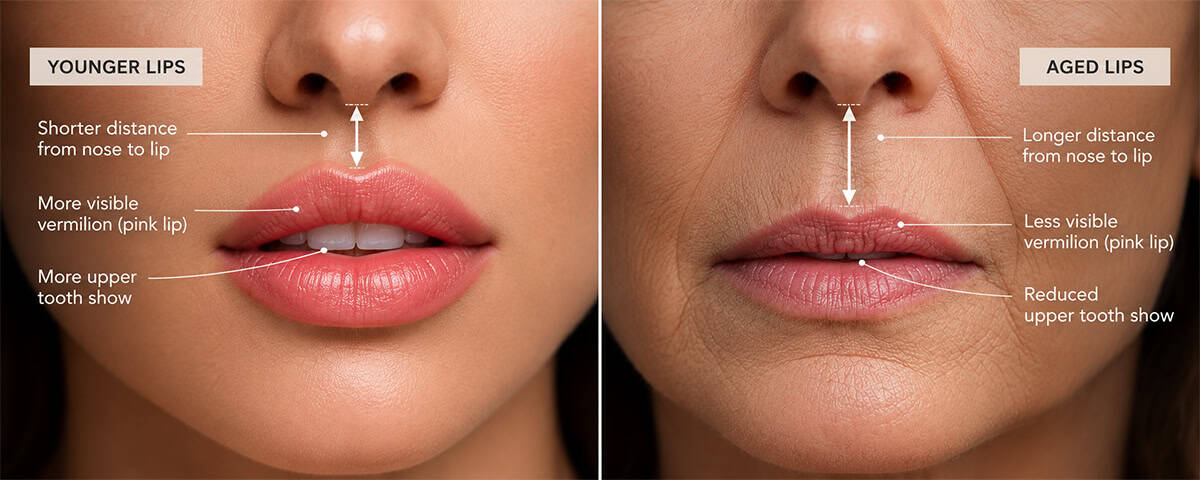
One of the first things I look at is the distance between the base of the nose and the upper lip. That distance can increase with age, making the cutaneous portion of the upper lip appear longer.
As that relationship changes, less vermilion, the visible pink portion of the lip, may show. The amount of upper tooth visible when the mouth is relaxed can also decrease. At the same time, the upper and lower lips may become thinner and lose some of their youthful projection.
This is why I do not automatically think about adding volume when someone tells me her lips look older.
A long lip and a deflated lip are not the same problem.
What Does a Lip Lift Actually Change?
A lip lift changes how much of the lip is visible by repositioning lip tissue rather than simply adding volume to it.
With a subnasal lip lift, I shorten the skin between the base of the nose and the upper lip. In the right patient, that can increase visible vermilion and improve upper tooth show.
That is fundamentally different from filler or fat transfer. Those techniques add volume. A lip lift changes position.
Neither approach is automatically better. They are tools for different anatomical problems.
INSIGHTS FROM DR. ATHRÉ
Lip Lift Explained: What Makes Lips Look Younger?
I explain how lips change with age, why lip rejuvenation is not synonymous with adding volume, and how I choose among different lip lifting and volume restoration techniques.
DIFFERENT ANATOMY, DIFFERENT SURGERY
There Is More Than One Kind of Lip Lift
When someone says “lip lift,” she is often thinking specifically about an incision beneath the nose. That is one approach, but it is not the only way I can change lip position.
Internal V-to-Y Lip Lift
An internal V-to-Y lift is performed through incisions inside the mouth. I can use it when I want to increase visible vermilion without making an external incision beneath the nose.
It is not simply a scarless version of a subnasal lip lift. The two procedures change the lip differently, which is why I choose between them based on the anatomy I am trying to correct.
Subnasal Lip Lift
A subnasal lip lift removes a carefully planned amount of skin immediately beneath the nose. This physically shortens the cutaneous upper lip and allows more of the vermilion to show.
The incision is designed around the contours at the base of the nose. It is still an external surgical scar, and I think patients should understand that clearly when deciding whether the tradeoff makes sense for them.
Corner Lip Lift
An upper lip lift does not necessarily solve a downturned corner of the mouth. If the lateral lip is part of what is creating the aged or unhappy appearance, I may need to address that area separately.
The Lower Lip Matters Too
I also look at the lower lip. Sometimes improving the upper lip alone creates the balance I want. In other patients, an internal lower lip procedure or subtle volume restoration may make the upper and lower lips work better together.
POSITION VS. VOLUME
Lip Lift vs. Volume: They Solve Different Problems
I understand why patients sometimes worry about lip rejuvenation. They have seen lips that look overfilled, excessively projected or simply out of proportion with the rest of the face.
That is not what I am trying to accomplish.
If a lip has lost volume, a conservative amount of volume may be appropriate. In patients already undergoing facial rejuvenation, I can sometimes use their own fat to restore softness and volume.
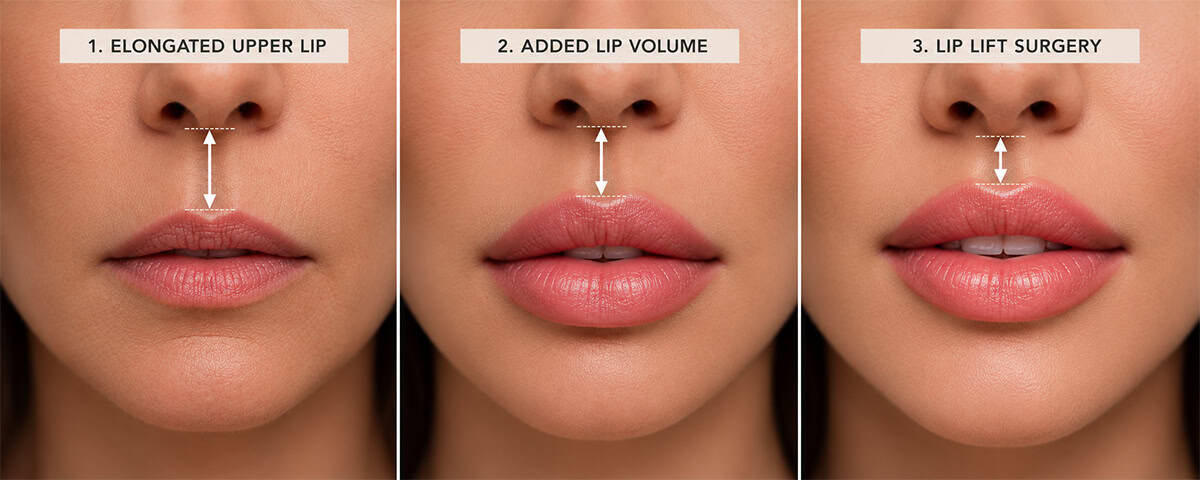
If the upper lip itself has become too long, continuing to add volume can be the wrong solution to the problem I am seeing.
I am not trying to create my version of the perfect lip. I am trying to understand your anatomy, what you find attractive, and how your lips should relate to the rest of your face.
Your Idea of a Beautiful Lip Matters
This is one of the areas where my patients have taught me a great deal.
I have treated patients whose preferred lip proportions were different from what I initially would have selected for them. That reinforced something important for me: aesthetic surgery cannot be based only on the surgeon’s personal definition of beauty.
I want to know what you like. I also want to understand what you do not like.
Pictures can be useful here. I am not looking at them because I can reproduce somebody else’s lips on your face. I am looking at them because they help me understand your aesthetic.
THE WHOLE FACE
How Lip Rejuvenation Fits With a Facelift
I do not think of the lips independently from the rest of the face.
A deep plane facelift can reposition descended facial tissues and improve the cheeks and jawline. A deep neck lift can address structures contributing to fullness or loss of definition beneath the jaw. Eyelid and brow surgery can rejuvenate the upper face.
None of those procedures directly shortens an elongated upper lip.
That is why I sometimes incorporate lip rejuvenation into a more comprehensive facial rejuvenation plan. It can also be part of my 4D Facelift™ when the lips are one of the areas contributing to the patient’s overall pattern of facial aging.
This does not mean every facelift patient needs a lip lift. It means I look at the entire face and decide which areas are actually contributing to what the patient sees.
BEFORE & AFTER
Lip Lift Results


Who Is a Good Candidate for a Lip Lift?
I do not decide candidacy from a single measurement.
I look at the length of the upper lip, vermilion show, tooth show, nasal anatomy, the corners of the mouth, lower-lip proportions and the relationship of the mouth to the rest of the face.
A patient with a naturally long upper lip may consider a lip lift at a younger age. Another patient may develop upper-lip lengthening as part of facial aging. Someone else may have an appropriate lip position but simply need a small amount of volume.
The procedure only makes sense when it addresses the problem that is actually there.
That individualized approach is central to how I think about facial plastic surgery. My background in head and neck surgery taught me to pay attention to anatomy first, and that continues to guide how I plan facial rejuvenation today. You can learn more about my training and approach.
WHAT IT CANNOT DO
A Lip Lift Does Not Solve Every Concern Around the Mouth
A lip lift does not replace lost volume throughout the lips. It does not automatically correct the corners of the mouth. It does not erase every vertical lip line. And it cannot guarantee a particular lip shape simply because a patient brings me a photograph of someone else’s result.
What it can do, in the right patient, is change the relationship between the nose, upper lip, vermilion and teeth in a way that better fits the rest of the face.
I don’t start by asking how much lip I can create. I start by asking what changed and which part of that change I can actually improve.
FREQUENTLY ASKED
Lip Lift Surgery FAQs
Lip rejuvenation can involve position, length, volume or several of these at the same time. These are some of the questions I hear most often when patients are trying to understand which approach fits their anatomy.
What happens to the upper lip as we age?
I commonly see several changes occurring together: the cutaneous upper lip becomes longer, the lip becomes thinner, visible vermilion decreases and less of the upper teeth may show at rest. MRI measurements have documented upper-lip lengthening, thinning and volume loss with age, while broader reviews of perioral aging also describe diminished vermilion and upper-tooth show. That combination is why I evaluate length, position and volume separately rather than assuming every aging lip simply needs more volume.
What does a lip lift actually do?
A subnasal lip lift physically shortens the cutaneous upper lip. That can expose more vermilion and increase upper-tooth show. A recent systematic review of surgical lip lift techniques found consistent reductions in philtral length along with increases in vermilion height and maxillary incisor show. I still individualize the amount and design because those relationships are different from one face to another.
Is a lip lift the same as lip filler?
No. They are addressing different variables. Volume restoration can replace fullness and architecture that have been lost, while a subnasal lift is designed to correct upper-lip length and position. The distinction between augmentation for volume loss and lifting for lip lengthening has long been part of treatment planning for the aging lip. In some patients I use one approach, and in others the anatomy may justify a combination.
Does a lip lift make my lips bigger?
It can make the upper lip look fuller because more vermilion becomes visible, but that is different from simply injecting volume. Three-dimensional analysis of changes produced by a subnasal lip lift demonstrated increased vermilion surface area along with shortening of philtral height and increased incisor show. I think about those changes as a repositioning of the lip rather than simply making the lip larger.
Can a lip lift improve tooth show?
Yes, in an appropriately selected patient. Aging tends to lengthen the upper lip and reduce maxillary tooth display at rest. A systematic review of lip mobility and dental display found that upper-lip lengthening with age is associated with less maxillary tooth show. Clinical studies of subnasal lip lifting have documented increased tooth show after shortening the upper lip, although the amount of improvement varies with anatomy.
Does a subnasal lip lift change the nose?
It can affect the relationship between the upper lip and lower nose, which is one reason I evaluate nasal anatomy when planning the surgery. One clinical study examining nasal and lip measurements after subnasal lip lift found changes in lip length, vermilion and tooth show as well as measurable changes in several nasal aesthetic parameters. I take that relationship into account rather than planning the lip in isolation.
Where is the scar from a subnasal lip lift?
The incision is designed along the contours immediately beneath the nose. Incision design, tension and surgical technique all matter, but I do not describe an external lip lift as scarless. The procedure requires a skin incision, and scar visibility varies among patients. Modern reviews of lip lift surgical technique emphasize respecting the natural anatomy and controlling tension on the skin closure as important parts of achieving a good result.
How long does a lip lift last?
A lip lift creates a structural change, but it does not stop the aging process. In a long-term study of patients who underwent a subnasal lip lift, shortening of the upper lip and improvement in lip show were maintained over time, although there was a gradual decline as aging continued. I think that is the right way to describe longevity: the surgical change can persist, but the face continues to age.
How do I know which type of lip rejuvenation I need?
I start by separating position from volume. Then I look at upper-lip length, visible vermilion, tooth show, nasal anatomy, the corners of the mouth, the lower lip and the proportions of the rest of the face. That individualized approach is consistent with the broader evidence on anatomy-driven lip lift selection. The goal is not to choose the same procedure for every patient. It is to identify what has actually changed and choose the treatment that addresses it.